Designing for biodiversity
Designing for biodiversity
Why biodiversity matters in every project
The statistics are clear: since 1990, wildlife populations in the Netherlands have halved on average. Habitats are disappearing or becoming fragmented, pollution is on the rise, and climate change is altering ecosystems faster than species can adapt.
But there is also another trend: more and more parties are viewing biodiversity as an integrated part of sustainable projects. Rightly so, because healthy ecosystems provide essential services: they purify water and air, mitigate climate extremes and contribute to our health and well-being.
As Witteveen+Bos, we directly influence what the physical living environment will look like. We work on infrastructure, water management and area development – projects that have a lifetime of several decades. The design choices we make today determine what nature looks like tomorrow.
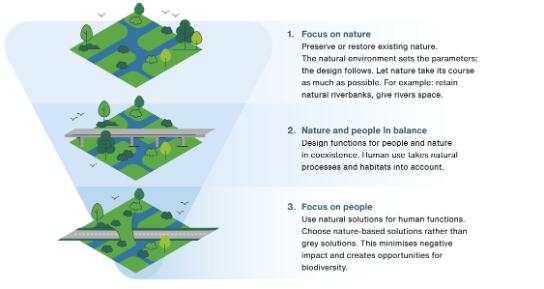
Trias Ecologica
When applying the EDPs, you use the Trias Ecologica to determine which measures are the most effective. This three-tier hierarchy, inspired by the Trias Energetica, helps you make conscious choices that support biodiversity.
The key objective: always aim for the maximum achievable (focus on nature). Only if this is not feasible should you consider the next tier down. This is how you maximise the impact.
Ecological Design Principles (EDPs)
At Witteveen+Bos, we view biodiversity as a design task. Measures to promote biodiversity are part of the design, just like other aspects of a project.
That is why we developed the Ecological Design Principles (EDPs): an aid that fits within our integrated design approach and helps you make design choices that enhance biodiversity.
The EDPs are intended for all disciplines, because it is precisely in a built environment or infrastructure – where nature is not a given – that the EDPs help us design for biodiversity. You can find specific examples of the EDPs in the visualisations for each of the sectors: Infrastructure, Hydraulic Engineering, Energy, Water and Environment.
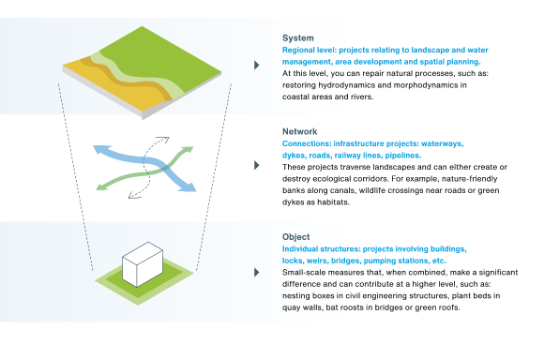
Levels and project types
Biodiversity can be enhanced in any project, regardless of the level. Whether you are working on a regional water strategy or the design of a single lock, the EDPs provide guidance.
The three levels - system, network and object - do not form a hierarchy in terms of their value. A well-implemented object-specific measure can also have an impact at the system level; for example, a single sheltered area can provide a spawning ground for fish, which in turn affects the entire aquatic ecosystem. The level does, however, determine what kind of measures are possible. Within each level, you apply the Trias Ecologica mentioned earlier: aim to focus primarily on nature, opt for balance if that is not possible, and use natural solutions when people are the priority. The illustration below shows the levels and explains the scope.