Juul Schuurmans
Employee portrait
Juul Schuurmans
‘I want to show people that it’s possible’
‘When I chose mechanical engineering at TU Delft, I knew I wanted to use my technical knowledge to make the Netherlands more sustainable. What I like about technical disciplines is that things can be factually accurate. You can argue about the best approach, but ultimately you have to determine together what’s correct from a technical perspective. In practice, that’s proven to sometimes be more complicated than I’d thought.’
Theory and practice
‘During my studies, I realised how important it is for me to combine theory with practice. I was involved as a mechanical engineer in developing a hydrogen-powered race car. My focus was on making the battery pack as efficient as possible. It was lots of fun. But I also performed a communications role and did PR at events. I’d speak to people who were less optimistic about sustainability. That’s when I first discovered how important communication is in our line of work.’
More than the technical side
‘I’m good at exact things. During my studies, I wasn’t really taught how to approach the social side of projects. Often, the calculations aren’t the hardest part – getting the message across is. Sometimes I want too much too fast, because for me sustainability ambitions don’t stop at my work. So projects on which sustainability isn’t a standard consideration present a challenge. Everything has to be perfectly calculated and substantiated beforehand if you want a chance of getting anything done. I most enjoy devising effective solutions together with the client – after all, they know the project best.’
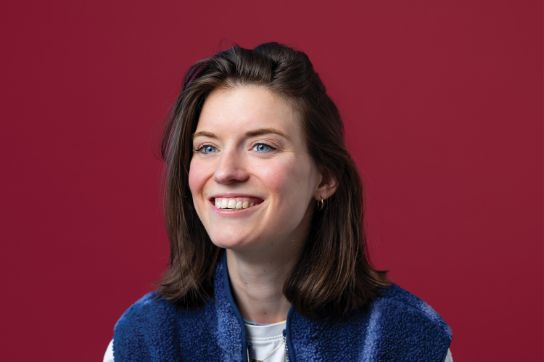
Sustainable design principles
‘I started working at Witteveen+Bos immediately after graduating. I could have gone into mechanical engineering but chose instead for the Sustainable Energy in Infrastructure group. Our goal is to show that a sustainable approach can go hand in hand with safety, quality, and cost efficiency. We use Witteveen+Bos’s sustainable design principles as our foundation. Ultimately, it’s about creating the best design with the smallest possible footprint.
‘A project like the renovation of the IJmuiden pumping station uses a huge amount of materials and energy. By exploring alternatives to concrete or by building entirely electric, we can really make a difference. That’s why, as a group, we get involved on as many projects as possible internally: Where is there still room for us to have an impact? We also do a lot of sessions with clients. The earlier we’re involved in the process, the more that’s possible from a sustainable point of view. It always starts with a good argument: making the calculations as solid as possible. If we can get something moving from there, it feels like a great victory.’