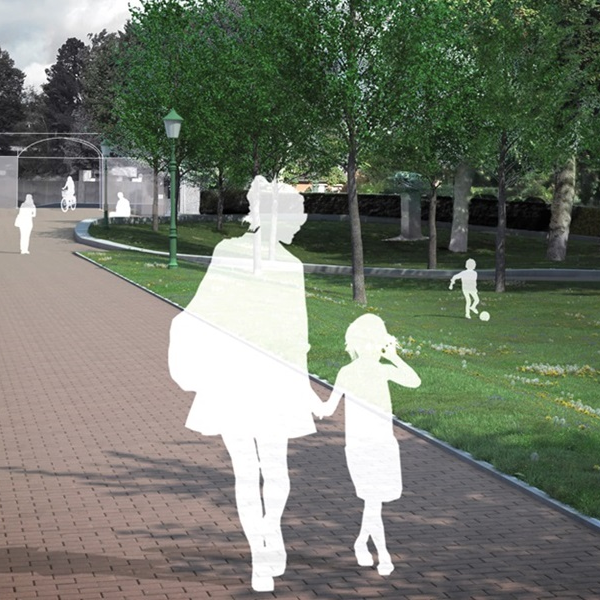
Water security and spatial quality in HWBP projects
Witteveen+Bos, H+N+S and Wing develop new approach focused on synergy
Water security and spatial quality in HWBP projects
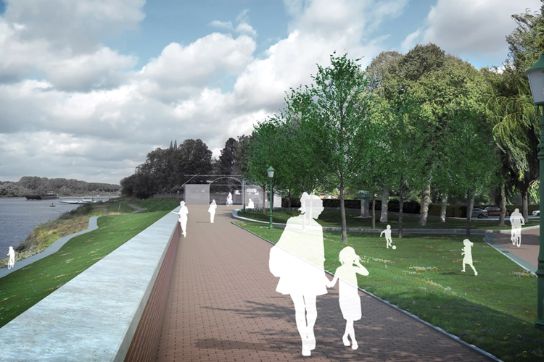
Climate change means that more and more space is needed to protect the Netherlands from high water levels. At the same time, this space is very scarce. This requires choices that are technically sound, but also fit in with the landscape, do justice to residents and are future-proof. Witteveen+Bos, H+N+S and Wing have developed a new approach to better organise the relationship between water security and spatial quality.
This approach was developed on behalf of the Ministry of Housing and Spatial Planning (VRO) and the national flood protection programme (HWBP). It shows how water security and spatial quality can reinforce each other, rather than hinder each other. By consciously exploiting opportunities for synergy and avoiding choices that block future solutions, more room is created for smart and robust measures.
Tools for policymakers
The approach offers concrete design concepts, promising instruments and inspiring practical examples. It thus provides guidance for policymakers, designers and administrators who work on the design of the Netherlands on a daily basis. Not by laying everything down in stone, but by guiding the discussion: what choices are we making now, and what do those choices mean in the long term?
Although there has been renewed attention in recent years for connecting water and soil with spatial plans, this has not yet been sufficiently translated into implementation. The area level in particular is underdeveloped and needs to be strengthened in order to implement local projects more efficiently and with greater social value. The approach is also intended to inspire further collaboration.
Principles of the Draft Spatial Planning Memorandum
The core of the recommendations is to fully embrace the three guiding principles from the Draft Spatial Planning Memorandum: multiple use of space, focus on area characteristics and prevention of shifting the burden.
These principles are intended to be applied integratedly and coordinated with all parties involved, across all scales, and communicated through to management and use. Collaboration at all levels, from local to national, is crucial, with integrators playing a connecting role between the different scales.
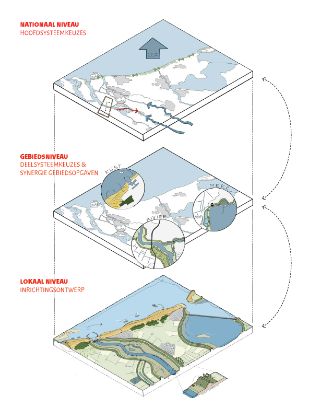
Design study
Design studies are recommended as a tool to promote innovation and joint decision-making by bringing together experts from different government bodies in “workshops”. The focus of the collaboration must be determined by carefully defining the integrated scope of each task.
In general, ensuring spatial quality in implementation and management requires improvement, with monitoring and knowledge sharing via existing platforms and training courses. Water security requires not only technical solutions, but above all mastery, creativity and connection between people at every level.
2026 and beyond
The parties involved hope that this approach will inspire further collaboration. At the beginning of December last year, an energetic foundation was laid for this during a launch event where the conclusions were presented to representatives of water authorities, the Ministries of Infrastructure and Water Management and the Environment, the Delta Programme Commissioner and the HWBP. The essence of the approach developed will also be implemented in the Sustainable HWBP Roadmap, so that project teams can apply the approach on projects.
The Ministry of the Environment and the national flood protection programme will continue their joint efforts in 2026 and expressly invite other authorities to join them. In this way, everyone's initiatives can be used to work towards a Netherlands in which water security and spatial quality go hand in hand.
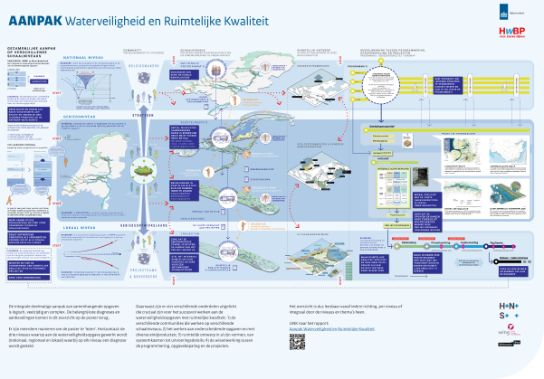
Link to the full report (only in Dutch): Handreiking: aanpak Waterveiligheid en Ruimtelijke Kwaliteit | Ruimtelijke ordening Nederland