Future for waste processing in Lier
Future for waste processing in Lier
IVAREM’s waste processing centre has operated on the same site in Lier for almost thirty years. Only: the world changed, the infrastructure aged, waste streams grew, and sustainability requirements tightened, so it’s no surprise the organisation is now running up against the limits of its site. IVAREM asked Witteveen+Bos to create clarity. How can the site be reorganised so it becomes future-proof, safe and sustainable again? Our feasibility study showed the way.
Growth needs space and vision
The core challenge was clear: the existing infrastructure no longer supports day-to-day operations. To keep guaranteeing services for the 295,000 residents in the region, IVAREM wanted to use the site more efficiently and explore new functions that add value.
We assessed the site from a legal and spatial-planning perspective, so the rules of the game and boundary conditions steering the redevelopment became clear from the outset. That gave IVAREM a realistic framework to work within.
Three scenarios
Based on IVAREM’s needs and the requirements of VLAREM II, we developed three scenarios. Each offered a different angle on the same question: how do you ready the site for the decades ahead?
-
Mobility as the engine (one large loop): one smart traffic loop serves all waste fractions and goods flows. Clear, safe and intuitive for visitors and staff;
-
Mobility in zones (multiple loops): several compact loops each serve their own waste stream. Fewer crossings, higher efficiency and more safety during peak times;
-
Spatial planning as the foundation: a layout fully focused on clear zones: separation of waste fractions, unambiguous logistics routes, calmer working conditions for staff, and room to add new functions.
From choice to master plan
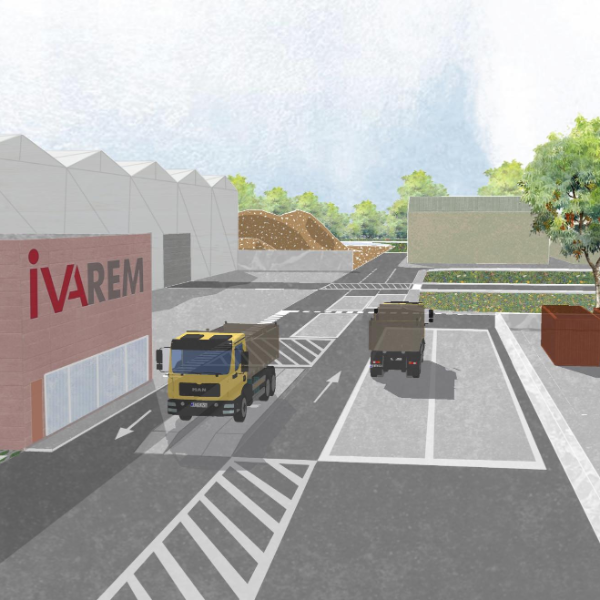
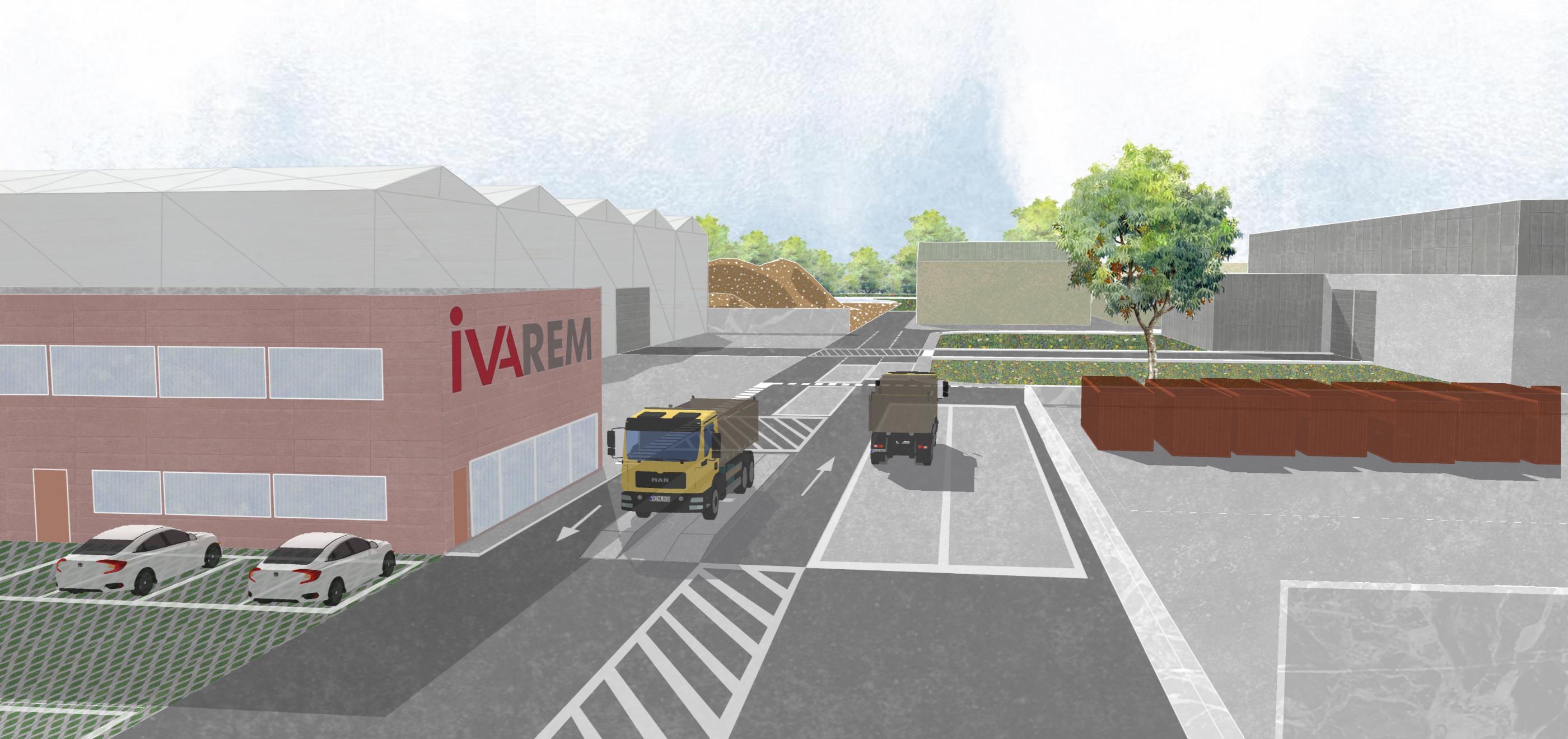
After consultation with the client, we translated Mobility as the engine into a full master plan that brings together mobility, water infiltration, sustainable materials, visitor routes, logistics and staff comfort.
The result? A future-facing design in which:
- waste streams move through the site in a logical and safe way;
- rainwater infiltrates as much as possible where it falls, and only (industrial) wastewater is discharged to the sewer;
- new infrastructure is integrated in a smart, spatially efficient manner;
- operations become smoother, safer and more climate-resilient.
With this feasibility study, Witteveen+Bos helps IVAREM take the step towards a sustainable, future-oriented hub for waste and resources.
In the meantime, we are working with Architeam and Infrabo on a follow-up phase, converting the master plan into an executable design.
.jpg)