The North-South Metro Line Amsterdam
Innovating with existing technologies
The North-South Metro Line Amsterdam
The North/South Metro Line, which was put into service mid-2018, is widely regarded as one of the most challenging infrastructure projects in Dutch history. It was this large-scale, complex project that prompted Witteveen+Bos, Royal HaskoningDHV and Ingenieursbureau Amsterdam to join forces under the name of Adviesbureau Noord/Zuidlijn V.O.F.
Technically complex project
During the design phase, the contract preparations and the supervision of the performance of work, the joint venture made a significant contribution to this technically complex project. A key precondition in the design phase was the requirement to retain the historical character of Amsterdam’s city centre. At the start of the project in 1994, this meant that the underground metro line could only be realised if conventional construction methods were applied in a very creative manner. Existing methods such as bored and immersed tunnel construction and pneumatic sinking of caissons have undergone radical innovation to suit the unique circumstances prevailing in Amsterdam. By developing these innovative methods, the Dutch engineering and construction industry has now gained an even stronger leading position in underground construction, both domestically and internationally.
Adviesbureau Noord/Zuidlijn made a special contribution to this technically challenging programme, not just in the design phase, but also during contract preparation and supervision of the works. One key requirement in the design phase was to retain the historical character of the city centre. At the start of the project in 1994, this meant that the underground metro link could only be realised if conventional construction methods were significantly refined.
This was achieved through major innovation, by refining existing tunnel construction technology such as bored and immersed tunnelling and pneumatic sinking of caissons, to cater for the exceptional circumstances in Amsterdam. Innovative development of the above technologies has allowed the Dutch tunnelling industry to become a frontrunner, both at home and abroad.
Featured technologies
Existing construction methods were developed in new ways to deal with the exceptional circumstances in Amsterdam. This complex programme of works included the following highlights.
Highlighted techniques
Existing construction techniques have been updated and innovated to adapt them to the exceptional circumstances in Amsterdam. The complex route features a number of highlights.
Bored tunnel technique
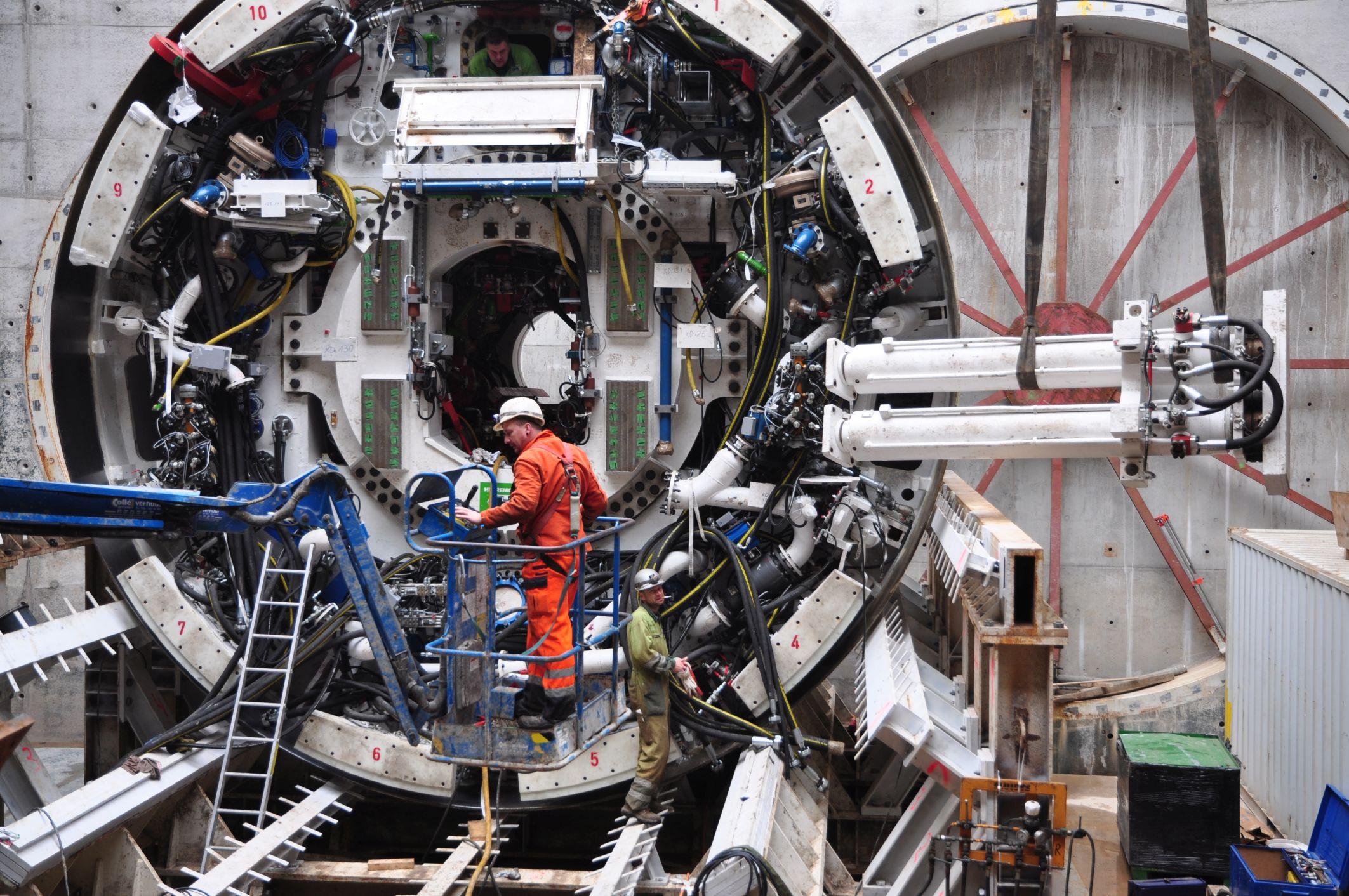
To enable boring in the loose soil Amsterdam is built on, an innovative tunnel boring machine was developed which, at the time, the world had never seen before. It was a very difficult challenge to move the four boring machines as carefully as possible in order to avoid the thousands of wooden and concrete foundation piles underneath the densely populated city centre of Amsterdam. The four tunnel boring machines, named Victoria, Molly, Noortje and Gravin, spent 2.5 years underground to bore the tunnels.
The bored tunnel between Damrak and Scheldeplein is 3.8 kilometres in length, including the metro stations Rokin, Vijzelgracht and De Pijp. The tunnel follows a practically straight line, running underneath existing streets. It comprises two tunnels with an internal diameter of 5.9 meters, which lie at a depth of between 20 and 30 meters below Amsterdam Ordnance Datum. On the Damrak-Vijzelgracht route, the tunnels are next to each other, and one over the other on the remainder of the route.The tunnel tubes between Damrak and Rokin were bored from north to south, the others from south to north.
A few facts and figures:
- the total tunnel boring distance covers 6,228 meters
- the tunnels are between 20 and 30 meters below Amsterdam
- the tunnels are made up of 24,858 tunnel segments
- tunnel boring took up 587 days over a period of 2 years and 8 months
- the average daily distance covered by the boring machines was 10.6 meters
- 40 boring machine operators, divided over four boring machine teams, worked on the tunnels
- the speed record was won by Victoria – she covered 30 meters within 24 hours
- 232,000 m3 of soil made way for the tunnels below Amsterdam’s city centre
Immersed tunnel construction
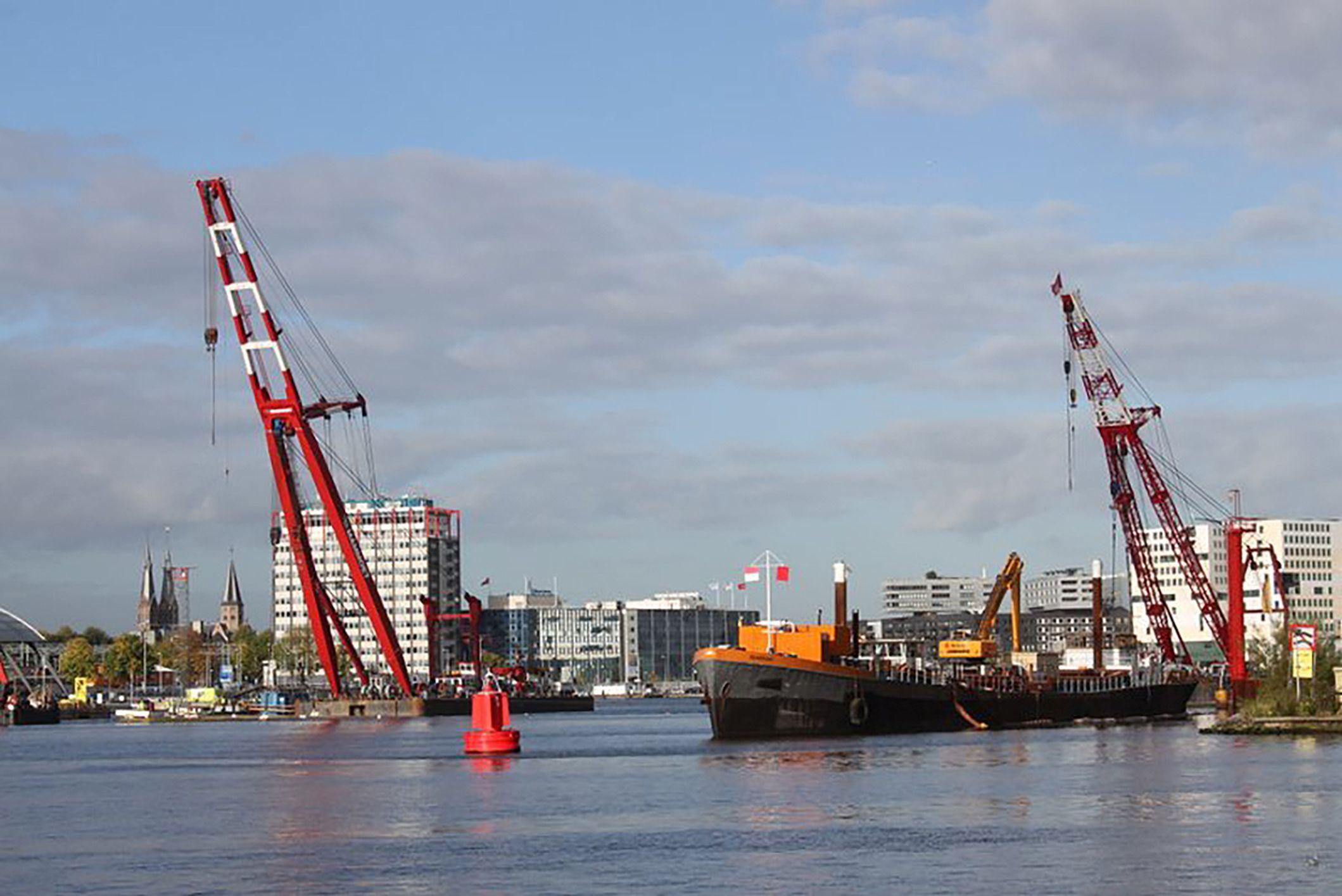
To construct the tunnel running below the IJ river and Central Station, the immersion method was used. Four tunnel sections were fabricated in a construction dock near the Sixhaven harbour. One section, to be positioned below the station, was 21 meters wide, 10 meters high and 136 meters long. The three sections making up the tunnel below the IJ river were 12 meters wide, 1 meter high and 141 meters long. A trench was dredged out in the bottom of the waterway to accommodate the tunnel sections.
'Table structure'
Creating the immersion trench below the station was many times more complex. While daily train services continued as normal and thousands of passengers were transported to their destination, a partial new foundation was installed below the station using a so-called ‘table structure’. This structure, measuring 130 meters in length and 20 meters wide, supports the station. The table legs are made of two parallel tube pile walls below the platforms and sandwich walls below the station concourse. The tube piles are 1.8 meters in diameter and up to 80 meters in length, and were installed by means of vertical microtunnelling. For the sandwich walls, two rows of tubex piles of up to 60 meters long were screwed into the soil, after which the space between the rows was reinforced using jet grouting. These walls are three meters thick. On top of the table legs, a roof was installed made of concrete piles poured on-site.
Tunnel section immersion
The soil below the station’s newly installed ‘floor’ was excavated, and the old wooden piles were removed. After the trench below the station had been connected to the three tunnel sections immersed in the IJ river, the fourth tunnel section was transported by ship to the trench below the station and immersed. The river’s water level was temporarily lowered for this purpose.
Caisson method
The immersed tunnel sections are connected to the central metro concourse below the square in front of Central Station. Between this concourse and Damrak, the metro tunnel was constructed using the so-called caisson method, which involves constructing a tunnel section (or caisson) on top of a sand bed.The sand is then gradually removed until it is at the required depth.
Deep stations
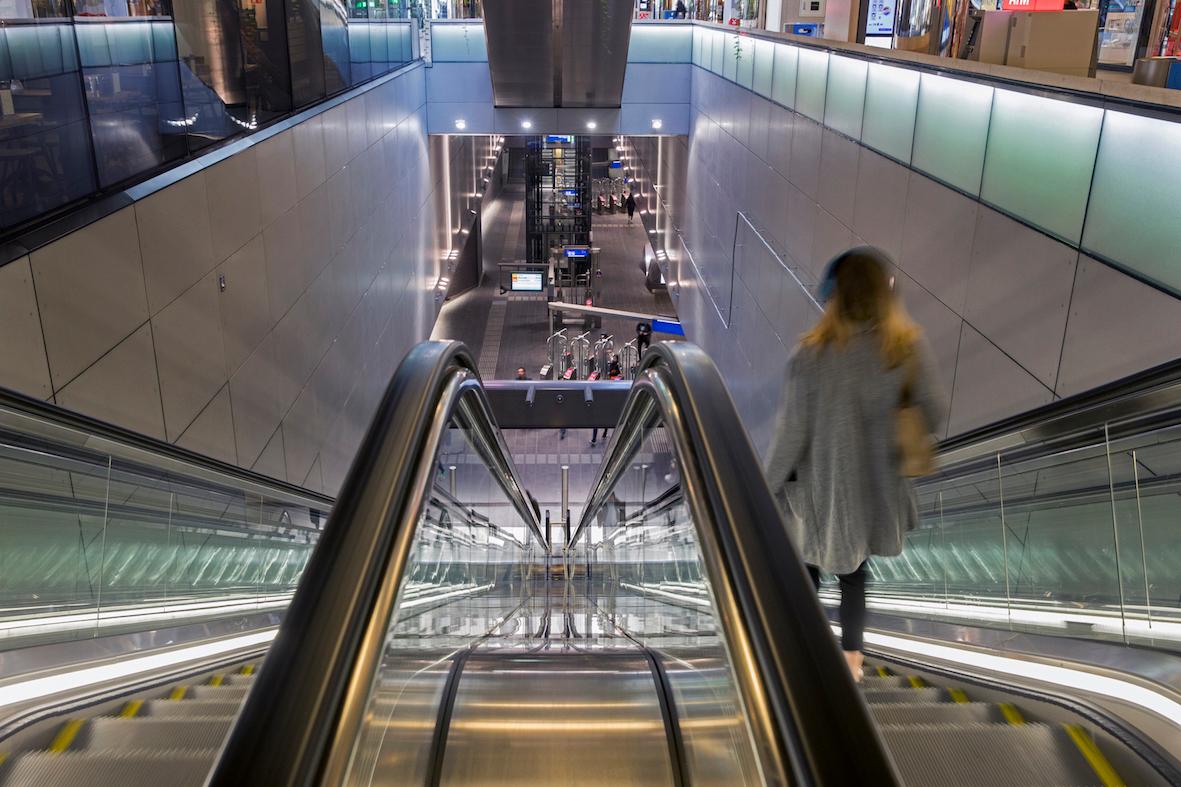
Four underground stations were constructed for the new metro line; Rokin, Vijzelgracht, De Pijp and Europaplein. All four were designed by Benthem Crouwel Architects. The first three are at significant depths – Rokin station is at 21.5 meters below Amsterdam Ordnance Datum (AOD). Vijzelgracht station is at 26 meters below AOD and De Pijp station, which has two storeys with platforms at each one, at 16.5 and 26.5 below AOD. These stations were constructed using the so-called walls-roof method, with diaphragm walls used to create the walls. Europaplein station is at 8 meters below AOD and was constructed in an open excavation.
Stations Rokin, Vijzelgracht and De Pijp
Three underground stations were constructed at significant depths – Rokin, Vijzelgracht and De Pijp. The tracks in these three stations are located far underground, at depths of 21.5 to over 25 metres. The stations were built using a special method based on diaphragm walls and grouting techniques, in some cases at a distance of just 3 metres from the historic facades of nearby buildings.
De Pijp station has superimposed platforms at two levels, since the tunnel tubes cannot be located next to each other below the narrow Ferdinand Bolstraat without prior demolition. Demolishing buildings for the construction of the North/South Metro Line had been ruled out on principle, making the design and construction of De Pijp station particularly complex.
Rokin station was excavated using innovative jet grouting techniques. At a depth of over 30 metres, the soil was reinforced using grout (a fluid form of concrete consisting of a mixture of water, cement and sand) to provide horizontal support for the walls, in order to minimise subsidence in the area.
Monitoring system
The monitoring system used for the construction of the North/South Line was a technically challenging project. The system showed how life above ground was influenced by working underground. The construction process and the environment were linked, providing insight into the moving position of the drill and its effects at street level. The flow of measurement data from buildings, ground level and subsoil was made transparent in real time and translated into useful information. The Mobonz system was specially developed for this purpose and can be considered one of the world's largest monitoring programmes.
The core of the monitoring system is a Geographical Information System (GIS). With this web-based GIS, the progress of the dynamic construction process and the settlements possibly caused by it are mapped online via the Internet. The designers and executors of the building processes use this information, which is displayed in the spatial context, to steer the building process and to react to the effects that occur. Thanks to flexibility and real-time insight into the behaviour of the home, the drilling process could be adjusted accordingly.
System functionalities:
- Control and storage of measurement data, in which the complete history, including changes, is recorded
- Real-time retrieval and visualization of measurement data
- Combining measurement and environmental data: buildings (photographs, data on hulls and foundations), cables, pipes and roads
- Analysis of data
- E-mail and SMS function to proactively inform data subjects
- Helpdesk functionality
Tunnel safety
At the start of the project in 1994, there was no discipline such as tunnel safety. Good regulations in this area were lacking and the construction decree fell seriously short of what was required for an underground station. The importance of the subject was strongly emphasized by a number of major tunnel incidents with many casualties, such as in Baku in 1995. Tunnel safety is about fire and crowding, about smoke development and the flow of people. How to evacuate as many people as possible in the shortest possible time.
To guarantee safety in the North/South Line, a whole range of measures has been devised. The North/South Line is quite unique, with deep stations and compact tunnels. People must have enough options to escape. This was something to take into account from the start of the design. Escape can be done by means of escape shafts, which are kept under overpressure to stop smoke, there are cross passages between the tunnels and the escalators are also necessary for evacuation. It was against the rules to use escalators for this purpose. Authorisation took years.
We also use the safe harbour concept, whereby the metro only leaves from one station when there is room for it at the next station. Many visible and invisible measures have been taken to maximise safety. This project has really set a standard here. The solutions that have been devised here have now also been used elsewhere, for example for the station in Delft and the metro in Brussels. It is a well thought-out integral safety system, in which a great deal has been invested.