Soil bioacoustics: a non-invasive method for measuring biological activity in the soil
Soil bioacoustics: a non-invasive method for measuring biological activity in the soil
Worms, beetles, spiders and other soil organisms play a key role in the functioning of soil ecosystems. When they move around, forage and communicate, they produce sounds that can be measured. The level of biological activity in the soil can be assessed using a microphone to capture soil sounds.
In the field of soil science, there has long been a focus on ‘overall soil quality’. In other words: the ecosystem services provided by the soil and the processes that underpin the soil’s ability to function well and thereby deliver these ecosystem services.
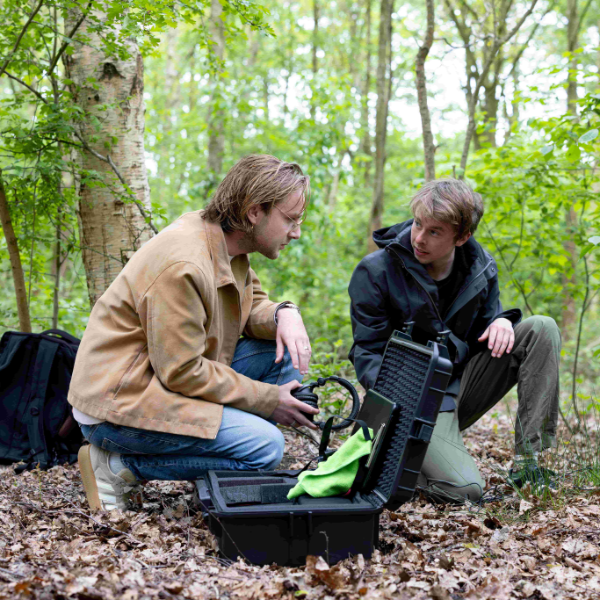
Bioacoustic measurements are taken using a contact microphone, which is equipped with a metal probe that extends to a depth of approximately 10 centimetres below the soil surface. The contact microphone is connected to an audio field recorder, which can be used to make high-quality audio recordings.
Bioacoustic measurements are usually taken repeatedly over an extensive period. This is because the biological activity of soil organisms can vary considerably depending on weather conditions, the time of day and the location within the same area. Taking measurements over an extensive period results in a representative picture of the biological activity in the soil – and by extension, the soil ecosystem – despite the transient and local nature of soil organisms.
Interpretation/analysis
The bioacoustic measurements are analysed on the basis of the intensity, variation and frequency distribution of the sounds. After this step, we draw up what is known as a ‘soil noise profile’ for a survey site. Witteveen+Bos documents the soil noise profiles, along with the associated interpretation and conclusions, in a survey report.
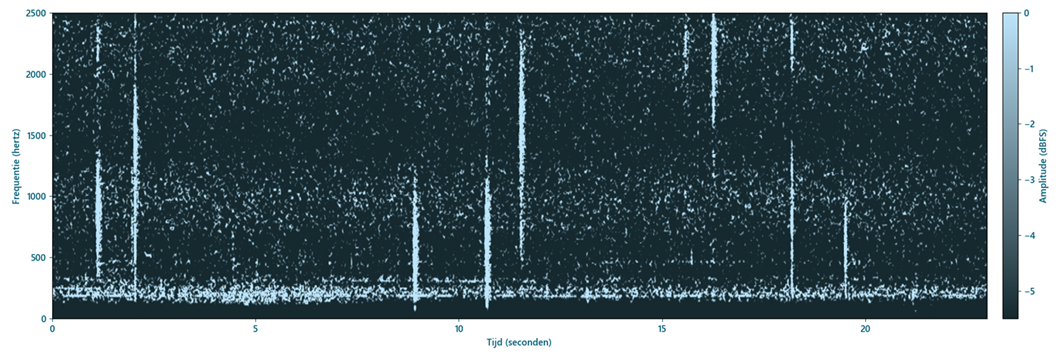
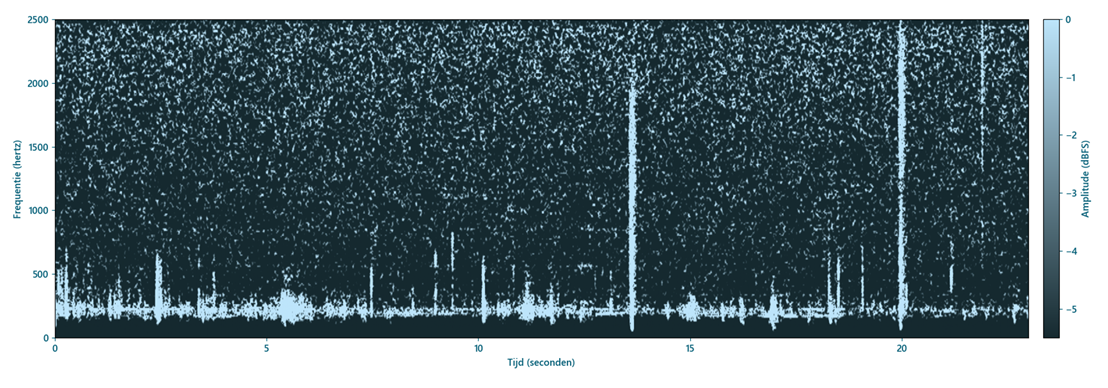
The images below show spectrograms captured during a bioacoustic measurement survey. A spectrogram is a visual representation of sound, showing the frequencies of a signal over time. The vertical axis shows the frequency in hertz (Hz). This analysis presents the bioacoustic range of soil organisms from 0 to 2,500 Hz. The horizontal axis shows time in seconds. The colour intensity indicates the amplitude of the sound in decibels (dBFS). When acoustic activity occurs within a specific frequency band at any given moment, this is visualised in the spectrogram as a change in colour. Lighter colours indicate a higher sound amplitude and therefore a higher level of acoustic activity, whilst darker colours indicate a lower amplitude and thus a lower level of acoustic activity. Listen to the accompanying sounds here.
Further information
Click here for 'Soil Sound Research in Practice: Mapping Soil Ecosystems: Listening to Worms, Spiders, and Insects' | Witteveen+Bos.
In a recent episode of Vroege Vogels - BNNVARA, Merlijn Schneiders discusses a new, non-invasive technique for detecting insects underground. Want to hear what that sounds like? Tune in at the 35:35 mark!
Sem Zeeman and Bart van der Kwaak from Witteveen+Bos contributed to the broadcast. Sjoerd J Faber, M.Sc., who works for Natuurmonumenten, was involved in this initiative as an intern.
Soil Bioacoustics surveys in practice
Witteveen+Bos is investigating the potential of soil bioacoustics as an innovative measurement and analysis method within its internal ‘Biodiversity and Climate’ programme. With this programme, we encourage every contribution and increase the collective societal impact.
Witteveen+Bos furthermore investigates how its company’s activities in the areas of sustainability, biodiversity and climate can reinforce one another. This innovative development in the area of soil bioacoustics is in line with one of the programme’s objectives: to contribute as much as possible to improving biodiversity by 2030 through consultancy and design services. Soil bioacoustics was used as an innovative measurement and analysis method in the recent ‘Vital Soils in Overijssel’ project (Vitale Bodems Overijssel).
Vital Soils in Overijssel
Several municipalities in Overijssel are collaborating to develop a practical and affordable measurement strategy for assessing soil vitality. The strategy also includes testing soil bioacoustics to determine the value of performing measurement surveys of this type in practice. Bioacoustic measurements were taken over a period of several weeks in various places in the municipality of Zwolle - in a city park, along a busy street and at a building site.
The measurements taken in the city park, in particular, successfully demonstrated the effectiveness of soil bioacoustics as a technique: sounds originating from soil life were consistently detected. The measurements taken along the busy street and at the building site served as an exercise in reducing disruptive ambient noise, highlighting specific areas for optimisation.
More information?