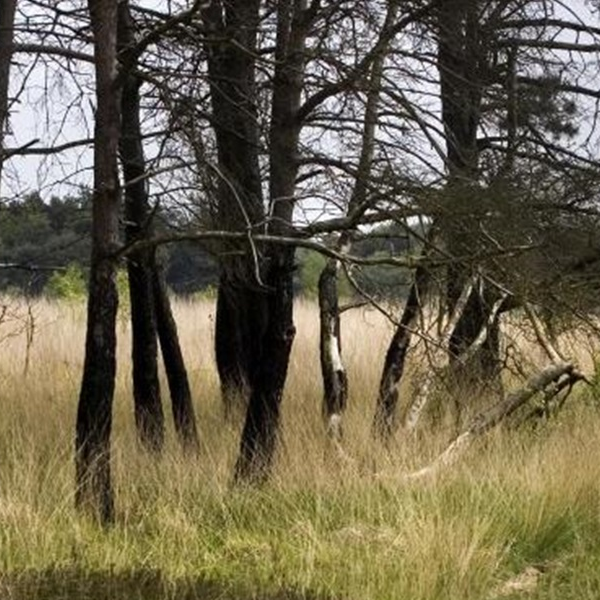
Area vision for Regte Heide & Riels Laag
Area-specific approach in practice
Area vision for Regte Heide & Riels Laag
Vulnerable protected habitats such as Regte Heide & Riels Laag are under pressure from drought, water quality and nitrogen deposition. This nature reserve is one of twelve areas where an Integrated Green-Blue Spatial Approach (GGA) is being implemented, with the aim of designing a sustainable future in collaboration with local residents.
Contributing to the decision-making process through research-based design
On behalf of the province of Brabant, Witteveen+Bos has been working on the GGA area vision for Regte Heide & Riels Laag for two years. Within this assignment, Lysias Advies provides process support to all stakeholders. The aim is to develop a broadly supported vision for the future, endorsed by all parties involved, together with a development strategy.
Major transition
This area, located on the border between the Netherlands and Belgium, faces a unique combination of challenges: climate change, nature, water, energy, economy, premises and social cohesion. This requires a radical transition of the entire area surrounding this Natura 2000 site, with consequences for farmers, residents and other stakeholders.
The complexity of the transformation around Regte Heide & Riels Laag calls for an area planning process with a participatory approach.
Water and soil as guiding principles
A characteristic feature of this stream valley is the presence of the Oude Leij and Poppelsche Leij streams. Central to the transition is the soil and water system around Regte Heide & Riels Laag, in line with the widely supported principle of water and soil-driven development. The broad approach to the (stream) valleys, which are cut into the ridges and lead to the flanks, is endorsed by all stakeholders.
For centuries, humans have manipulated the current water system under pressure, resulting in disruption of the system. By utilising the natural power and processes of the area, the system will be restored and the foundation will be laid for a robust and future-proof soil and water system that can continue to be used by humans and animals in the future.
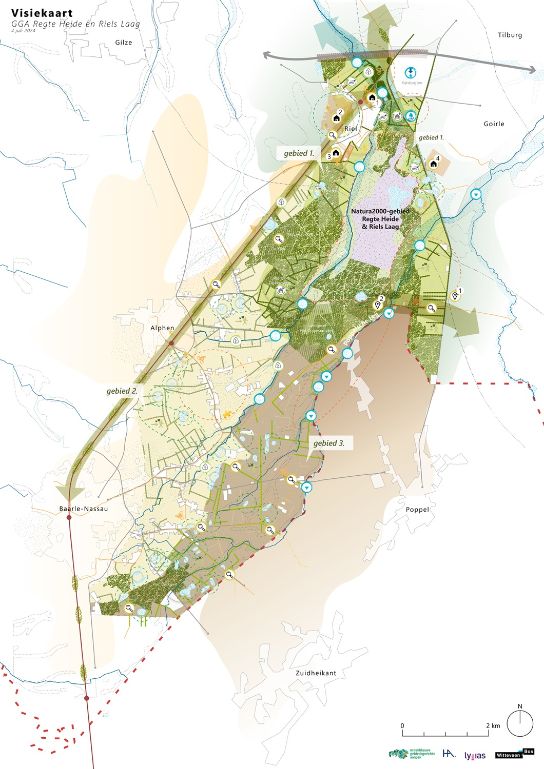
Natural values and human needs
The restoration of natural values, the resolution of water quality and quantity problems and the reduction of nitrogen deposition are combined with meeting human needs: improving the landscape experience, recreational opportunities and future-proof agriculture.
Various working groups with stakeholders (including farmers and residents) have identified the spatial qualities, opportunities and bottlenecks in the region.
Integrated sketching sessions have facilitated the process of making guiding choices on themes such as water, agriculture, liveable countryside and nature.
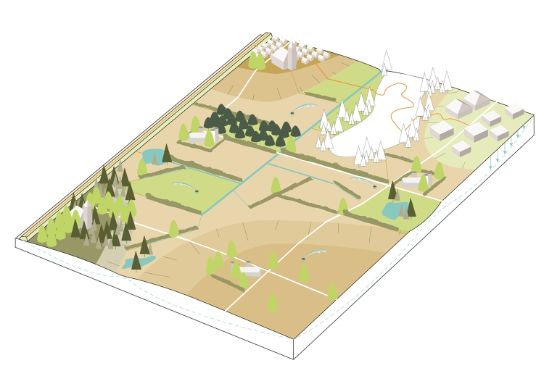
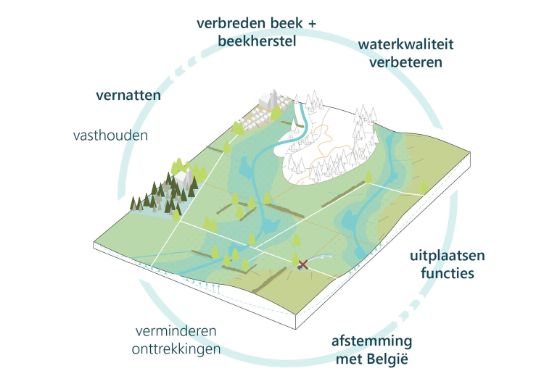
Design process supports decision-making
Our landscape architects not only provided the design and facilitated participation sessions, but also helped to translate complex information into visual terms, making these topics understandable to a wide audience. The design process, based on research, supports the decision-making process.
The end result of the integrated green-blue area approach is an area vision in which the preservation of the Natura 2000 area is anchored from a water and soil-oriented perspective, while at the same time offering future prospects for entrepreneurs and residents of this region. These aspects are now being further elaborated in the planning phase, with an emphasis on a feasible and practical design.
More information