H2avennet: green hydrogen for more sustainable industry
H2avennet: green hydrogen for more sustainable industry
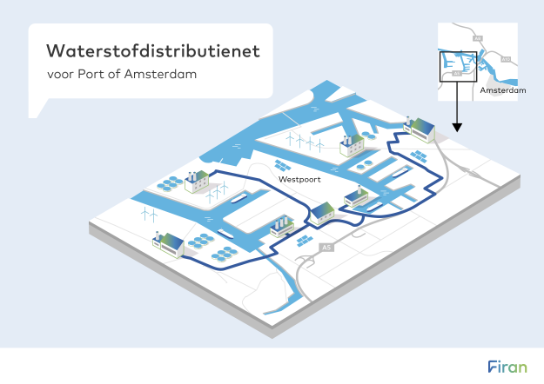
Port of Amsterdam and Firan Hydrogen are developing an industrial hydrogen distribution network in the city’s seaport: H2avennet. The network will contribute to making the industry in the area more sustainable. Witteveen+Bos collaborated with WSP to produce the detailed design and financial feasibility analysis.
The energy transition in the port will require more than just electrification. Several companies in the Port of Amsterdam use industrial processes that are difficult to fully electrify, due factors including the high temperatures required and specific process requirements. Hydrogen offers an alternative to fossil fuels, both as an energy source and as a raw material.
Phased hydrogen network
With H2avennet, Firan is developing a phased hydrogen network with a length of around 24 km and a design pressure of 16 bar in close collaboration with Port of Amsterdam. In the future, the network can be connected to the national hydrogen grid (Gasunie/HyNetwork Services) and to several import terminals for the import of LOHC (Liquid Organic Hydrogen Carriers) and liquid hydrogen. The design allows for more than 15 potential industrial users.
Justification for investment decision
The route passes, among others, under a railway and the North Sea Canal, which requires detailed technical planning and carefully formulated prerequisites. The detailed design was developed to a level that allows the client to take the next steps, while taking account of safety, the local environment and costs.
Safety and technical assurance
The detailed design includes an integrated safety assessment. Witteveen+Bos supplied a Structured What-If Technique (SWIFT) risk assessment and a QRA (Quantitative Risk Assessment). Pressure drop and flow rate calculations were also carried out, and interference calculations (EMC) will be prepared to ensure interactions with neighbouring electrical infrastructure.
Cost estimate
A class 1/2 AACE cost estimate was carried out in the initial design phase. This included various scenarios and a risk assessment for the planning of the construction works. The client can use the design and financial feasibility assessment to take the next steps towards realisation.
We carried out the following works in the context of H2avennet:
- project management;
- pressure drop/flow rate calculations;
- interference calculations (EMC);
- coordination of environmental studies (soil, nitrogen emissions, ecology, archaeology);
- accessibility, safety, liveability and communications framework;
- SWIFT assessment and QRA;
- construction planning and risk assessment;
- cost estimate;
- technical project-specific work description for the tendering process.