Centralised sludge digestion
A step forward in the energy transition
Centralised sludge digestion
Wastewater treatment plants (WWTPs) are contributing to the energy transition by using sludge digestion to produce biogas. This is then upgraded to green gas, which can be fed into the natural gas network. To make this process more efficient, water authorities are centralising it. Witteveen+Bos is currently working on two large-scale projects to do this.
The production of green gas has received greater political attention in recent years. This is due in large part to an increased dependency on imported gas in an uncertain geopolitical landscape, but it also has to do with the EU’s net reduction targets for greenhouse gas.
This presents opportunities for water authorities and other producers of green gas to make their business operations more sustainable, contribute to net-zero and circularity ambitions in the Netherlands, and – depending on market demand – benefit financially. It was therefore with good reason that Unie van Waterschappen, the union for water authorities in the Netherlands, announced in 2022 its ambition to increase biogas production from 145 million m³ to 175 million m³ by 2030, with at least three quarters of this being green gas.
Centralised approach
But the question is how water authorities will approach this challenge. Part of the answer lies in technological advances (i.e. more efficient processes) and part lies in organisation. Traditionally, sludge digestion has been segmented, with WWTPs often digesting their own sludge regardless of capacity.
According to research in 2022 by Unie van Waterschappen, a centralised approach can increase green gas production by a factor of 2.5. To realise this optimisation, a state-of-the-art sludge digestion installation is needed that can be further optimised over time. The operating costs of such an installation (e.g. for maintenance) would be lower than those of multiple smaller and generally outdated installations, and less – and drier – sludge would need to be disposed of, resulting in lower processing costs. In short, green gas offers an attractive source of revenue to water authorities.
Increased efficiency and sustainability
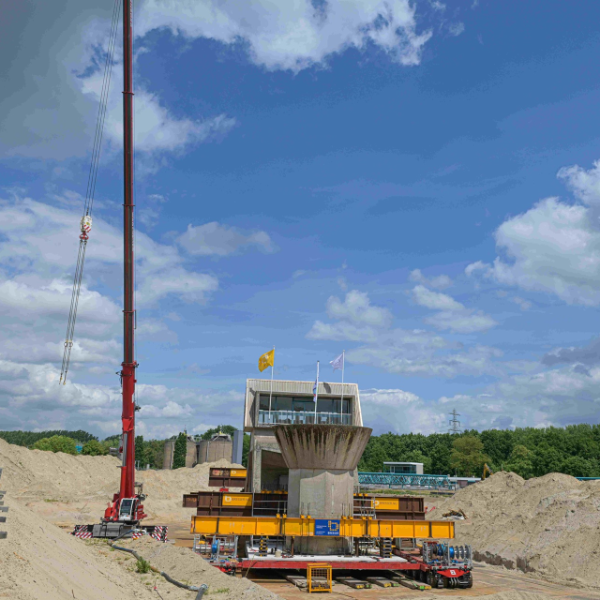
Some water authorities have already chosen to centralise part of their sludge digestion. The Vallei en Veluwe water authority, for example, has done this with an installation in Ede. Starting in 2027, this installation will process sludge from the WWTP in Ede as well as other WWTPs in the southern region (i.e. Veenendaal, Renkum, Woudenberg and Bennekom).
This centralisation of sludge digestion will result in increased processing efficiency and sustainability, as well as a proportional increase in biogas generation. In a separate installation, the biogas will be upgraded to green gas, after which it will be fed into the natural gas network. The green gas produced will supply 2,200 households each year with energy that is more sustainable. The CO2 that is released will also be safely captured and sold.
Side by side
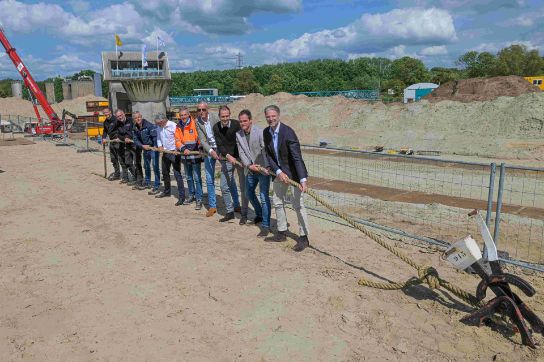
Since 2024, the water authority has worked together with CLC Water on the design and construction of the installation. CLC Water is a collaboration involving ADS Group, Nijhuis Saur Industries (not involved in this project), Witteveen+Bos, Pannekoek GWW, and Moekotte; it is supported by Iv. Construction of the installation has commenced, and a similar team has started on the design of an even more complex installation in Geestmerambacht (Noord-Holland) for ADS Group.
According to technical manager Hans Smit, working in a construction team has proved successful. ‘Client and contractor go through the process side by side – from the very beginning through to completion. This accelerates the design process and reduces the risk of unpleasant surprises later on. Design, stakeholder management, and construction are brought together at an early stage, allowing us to deal with any obstacles earlier. The design of the silos for the digested sludge is an example. Height restrictions meant that the diameter needed to be greater, which had consequences for design, transport and construction.’
Uncertainties
Hans believes that integrating the permit and design processes is crucial to avoiding disappointments on similar future initiatives: ‘In the design process, we need to take uncertainties into account – for example, the dimensions of a building – and work with a design that will be fleshed out later. Sometimes, it’s smarter to design something to be slightly larger – and thus more expensive – to avoid running into problems after the permit request has been submitted.’
As regards uncertainties, nitrogen and grid congestion were considered in both the construction and operation of the Ede installation. It was designed to minimise NOx emissions and avoid grid congestion through smart options for peak shaving.
Hans adds that, rather than technical processes, the human aspect comes first: ‘Regular contact is needed for coordination, but also for team building. If the partners in the construction team are attentive to each other’s interests, it creates a better flow in the design process.’