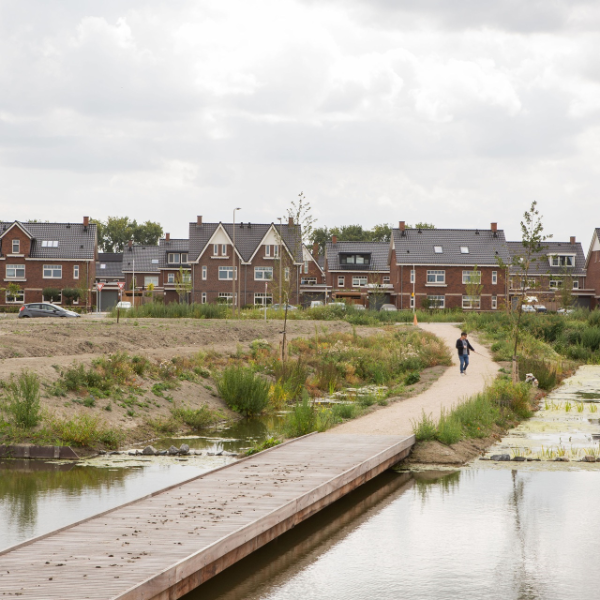
Area development of Wilderszijde residential area
Climate-adaptive and nature-inclusive on five scales
Area development of Wilderszijde residential area
Wilderszijde is an area development in Bergschenhoek, just north of Rotterdam, where approximately 3,000 homes are being built. The municipality of Lansingerland formulated ambitious sustainability goals for this residential area and selected Witteveen+Bos to design Wilderszijde in a climate-adaptive and nature-inclusive manner.
Wilderszijde is located in the middle of a green corridor between the Lage Bergse Bos and Schieveen Nature Park, with the shape of the site reminiscent of a bow tie. The location for Wilderszijde is on the spur of this bow tie. Therefore, in addition to its residential function, the neighbourhood also plays a crucial role in the ecological and landscape connection between these nature areas.
Wilderszijde consists of 16 neighbourhoods that will be realised between 2024 and 2028. Witteveen+Bos's assignment on this project is comprehensive: creating the integrated design for the public space, the main infrastructure and the structures. We also provided the integrated design for the construction sites on behalf of the developers. In all cases, this was done in such a way that life, living and nature reinforce each other.
Cohesion between public and private spaces
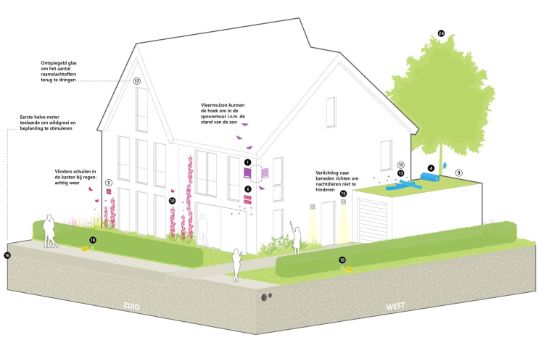
Our designs incorporate extensive standardisation of ecological solutions, including the forms of streets, bridges, gardens and houses. Universal application and the capacity to be scaled up were two important design considerations.
A strong cohesion between public spaces and private buildings was also crucial. This is essential to genuinely nature-inclusive design. After all, animals do not stop at property boundaries, instead moving freely between public spaces and private gardens and buildings.
The Municipality’s ambition to make Wilderszijde a nature-inclusive district has been embraced by developer BBGZ, a collaboration between Batenburg Bouw & Ontwikkeling, BPD (Bouwfonds Property Development), and Zondag Ontwikkeling. This has made it possible for climate adaptation and biodiversity measures to not only be applied in public spaces but also in private buildings and gardens.
Five scales
A holistic ecological approach is being applied at five scales: wider community, district, neighbourhood, courtyard, and building. At each scale, strategies have been developed to create specific habitats and enable animal migration and daily interaction between humans and wildlife.
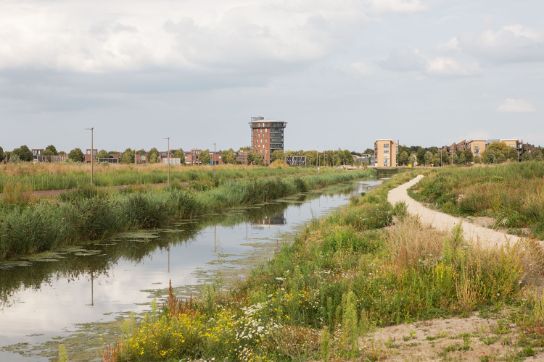
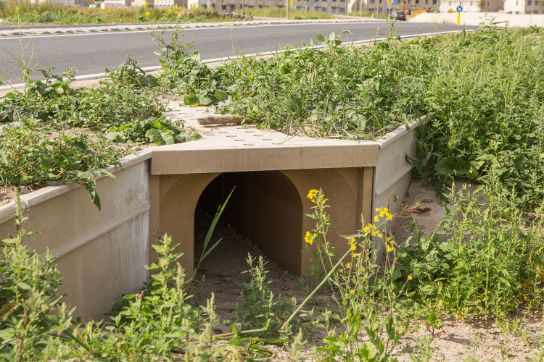
Fundamental to this ecological approach is the incorporation of a robust underlying green structure into the design – one that connects the district to the wider living environment and residential community. At locations where ecological challenges for animal populations could arise, fauna passages have been designed which allow animals to freely enter and leave the district.
At the district scale, the importance of cohesion between public spaces and private property is illustrated by the diagonally crossing route known as the ‘hedgehog highway’.
Along this route, terrestrial mammals can move across the entire district. Plots adjacent to the route feature deep front gardens and green hedges that guide the hedgehog’s journey and provide shelter. Hedgehogs are also able to enter the neighbourhoods and private gardens along the route through holes in the fences separating individual properties. This ensures that hedgehogs not only inhabit public spaces but also private gardens, which maximises their habitat and promotes genuine interaction between residents and wildlife.
Throughout the district, bird nesting boxes have been integrated into homes. To create a reliable nesting site for birds, it is essential that food is available nearby. The choice of plants in public spaces was therefore carefully coordinated with the needs of local bird species. As a result, the food these birds need for themselves and their offspring is available in the immediate vicinity of the boxes.
Marshy banks
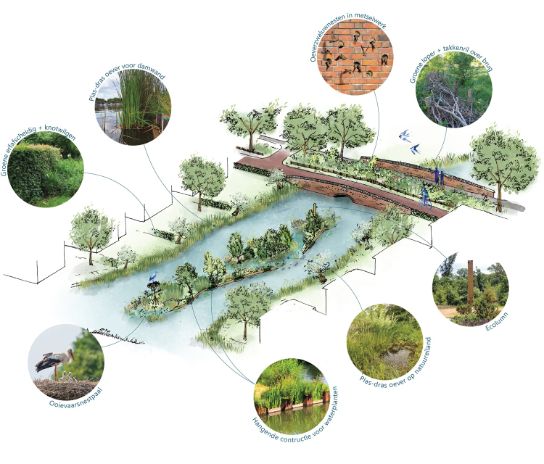
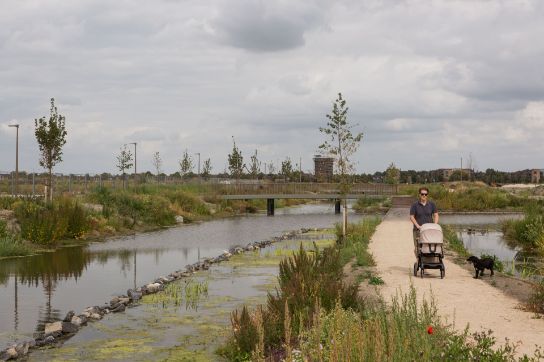
The way in which a unique living experience and nature-enhancing measures can be brought together is visible in Polderwijk phases 3 and 4, which incorporate pollard willows and lots of open water. Additional ecological value is generated by marshy banks along the water.
Thanks to constructive collaboration by the municipality, BBGZ, and our designers, a good balance has been found between sizeable gardens and nature-friendly banks. The result is a significant amount of new habitat in Polderwijk for the southern marsh orchid and animals such as the bluethroat, the sand martin, and the smooth newt.
The underlying green structure has also been modified to ensure that the smooth newt can reach the marshy banks, with amphibian ledges being incorporated into primary watercourses. These ledges allow newts to reproduce safely by preventing fish from eating their eggs.
Home for humans and animals
The courtyards in Polderwijk phases 3 and 4 are another example. They have been designed to form a north-south ecological route through the neighbourhoods, providing shelter for ermines and hedgehogs. The greenery in the courtyards and the fact that cars are not welcome ensure that residents are also offered a pleasant living environment.
Wilderszijde is an inspiring example of how human comfort, recreational quality, biodiversity enhancement, and ecological integration can go together. With a holistic ecological approach as the foundation, nature is made an ordinary part of everyday life. Not only people but also animals have a year-round home in Wilderszijde – as an integrated part of the living environment, not adjacent to it.
The central figure
‘The Municipality of Lansingerland has put climate adaptation and integrating nature at the heart of Wilderszijde from day one. The area’s location below the Amsterdam Ordnance Datum and its soil structure required different thinking, resulting in a complete plan for nature and climate,’ explains Bregje van Spaendonck, the Municipality of Lansingerland’s project manager for the Wilderszijde area development.
Witteveen+Bos has been the central figure in converting the ambitions of the Convenant Klimaatadaptief Bouwen – a collection of agreements on climate-adaptive construction – into practical area development. ‘The principles of the Convenant were made concrete using a funnel method, and the underlying water-and-greenery structure was fully integrated into the zoning plan. This was done in observance of policy rules and environmental impact assessment obligations, with a matrix of nature-inclusive measures providing – and continuing to provide – important guidance for making choices.’
Witteveen+Bos then provided an integrated design for the primary infrastructure, civil engineering structures, and public spaces, with the natural soil-and-water system guiding choices. We subsequently commenced work at the level of individual properties for a development consortium and have now been part of the project team for four years.
‘That Witteveen+Bos’s experts don’t just come up with a single definitive solution for each challenge – like traditional consulting firms – is unique,’ emphasises the project manager. ‘Instead, they analyse the objectives from an integrated perspective and convert them into a range of choices in various scenarios, providing insight into the pros and cons. This ensures the project team produces the best solutions – with maximal synergy – and that everyone works together on integration and sustainability. That’s genuine added value: consultancy 2.0.’
‘We looked for the balance together and found it’
Zondag Ontwikkeling has been a developer of high-quality housing for 51 years. In Wilderszijde, it is constructing about 1,000 of the 3,000 homes.
‘When we signed the collaboration agreement in 2021 with the other parties and the Municipality of Lansingerland, our director Bob Bax realised that nature-inclusive and climate-adaptive construction needed to be given a central role in Wilderszijde,’ explains Chris Gmelig Meijling.
To give this ambition form, they sought collaboration with Witteveen+Bos, already active as the Municipality’s ecological consultant. Witteveen+Bos subsequently helped make options measurable and quantifiable using a matrix of nature-inclusive measures. This resulted in a healthy balance between natural interests and residential comfort.
‘We’ve come to know Witteveen+Bos as proactive, ambitious and stimulating – but also understanding of commercial considerations. Some measures were scrapped for this last reason, or swapped for a variant more in line with the desired residential experience.’
During the preliminary phase, Zondag Ontwikkeling and Witteveen+Bos invested significant time in their collaboration and coordination, so that advice could be effectively integrated into the planning and design phase. Chris Gmelig Meijling: ‘This enables us to always choose the optimal solution together – with the most positive impact on nature.’
One practical example is the construction of houses with bat-friendly outdoor lighting next to the front doors. ‘The uniformity creates a stylish appearance, and we prevent bats being kept away from their boxes by overly bright lighting. So it’s win-win: good for nature and good for residents.’
More information

.jpg)