Insight into soil ecosystems
Listening to worms, spiders and insects
Insight into soil ecosystems
Worms, beetles, spiders and other soil organisms are important indicators of the functioning of soil ecosystems. When they move, forage and communicate, they produce sound – and you can measure that! By listening to soil sound with a microphone, the bioactivity in the soil can be mapped. Witteveen+Bos believes in this new technique and has been researching the potential of soil sound for the Netherlands for the past year and a half.
Compared to conventional methods, soil sound measurements are a cheaper, more accessible and non-invasive technique. Soil ecosystems are of great importance to the functioning of nature and, consequently, to the natural processes on which society depends.
The soil provides ecosystem services, such as water regulation in the soil, nutrient availability, fertility and carbon storage, which are essential for, amongst other things, agriculture, effective management of nature reserves, Climate Adaptation in cities, coastal defence and water management.
Anchored in the Environment and Planning Act
In society, among citizens, government and politicians, there has long been a focus on soil quality in the broadest sense. The Environment and Planning Act has further enshrined this importance by explicitly incorporating broad soil quality into an integrated approach to soil.
The EU Soil Monitoring Directive goes a step further and aims for a European approach to mapping soil health. In practice, soil sound measurements fit well with this, for example:
- monitoring nature restoration in rural areas;
- assessing the health of an urban park;
- tracking the impact of interventions in nature conservation.
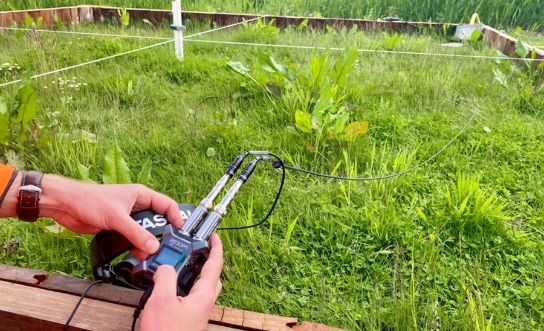
Soil probe
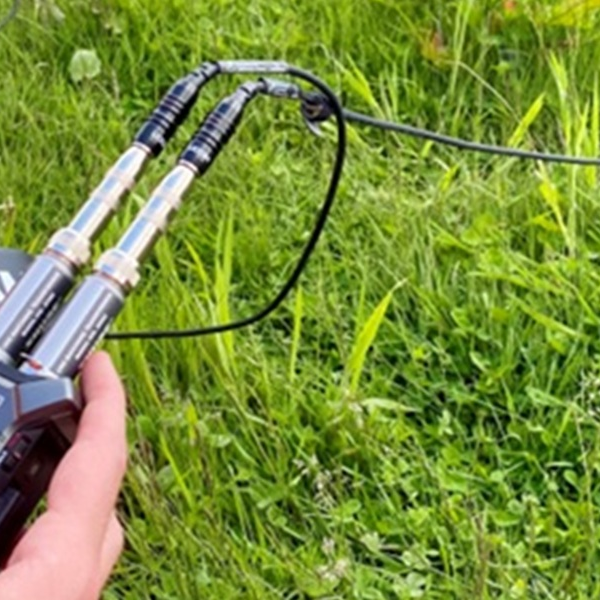
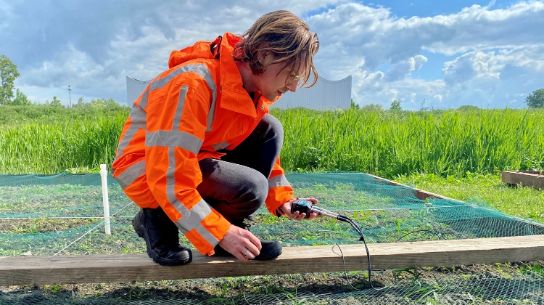
Soil sound measurements are carried out using a contact microphone, which is fitted with a metal probe and reaches to approximately 10 centimetres below ground level. The contact microphone is connected to an audio field recorder, which enables high-quality sound recordings to be made.
Soil sound measurements are usually carried out repeatedly over a longer period. This is because the bioactivity of soil organisms can vary significantly depending on weather conditions, the time of day and the location within the same area. By carrying out measurements over a long period, a representative picture of the bioactivity in the soil – and thus the soil ecosystem – is obtained, despite the temporary and localised nature of soil organisms.
Audio analysis
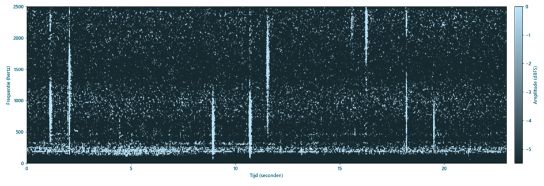
Soil noise measurements are analysed using acoustic indices; these are quantitative measures that summarise characteristics of soil noise into numerical values. The indices are based on factors such as the intensity, variation and frequency distribution of the sounds.
Based on these indices, a so-called ‘soil sound profile’ of the research site in question is established from all soil sound measurements taken together. The soil sound profiles, along with the associated interpretation and conclusions, are documented by Witteveen+Bos in a research report.
Projects
A recent project in which ground noise has been used as an innovative measurement and analysis method is ‘Biodiversity in Focus’, ‘Vital Soils Overijssel’. Several municipalities in Overijssel are collaborating on the development of a practical and affordable measurement strategy for determining soil vitality. Soil noise measurements are also included in this, as a trial for carrying out soil noise measurements in practice.
More information?