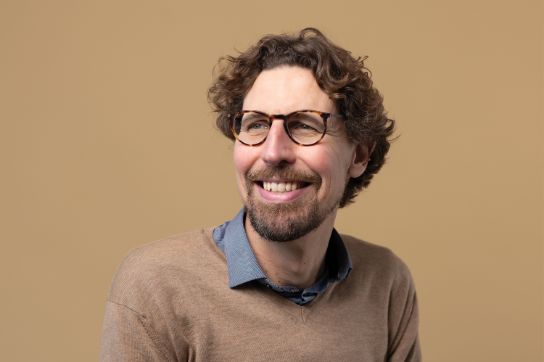
Sebastiaan Schep
Employee portrait
Sebastiaan Schep
‘If you understand the system, you can take the right action’
‘I’m always interested in the bigger picture. Whether it’s water quality, biodiversity, or the way we collaborate: only when you understand how a system works can you take the right action.’
Hard science and social science
‘I’ve always had that broad outlook. As a child, I enjoyed listening to adult conversations and was interested in social issues. The Chernobyl disaster made a big impression on me. It made me environmentally aware. I chose environmental subjects so I could combine aspects of hard science and social science. In various places around the world at the time, including Siberia and the Philippines, I saw how serious water problems could be. It became clear to me that water doesn’t stand alone – it’s always a question of systems and the social context in which those systems operate.’
A systematic approach
‘One of the first assignments I worked on was a systems analysis of the various waterbodies in the Loosdrechtse Plassen natural area. You’d expect to find clear water there, but it was turbid and contained high levels of algae. To understand how that was possible, I went way back in time: I explored archives, reconstructed data, and combined models. The quality of a waterbody is an extremely slow reaction to causes that can go back decades. Finally being able to solve such a puzzle is one of the best things about my job.
‘I noticed that, in practice, different approaches are taken to ecological issues. If you ask ten ecologists the same question, you’ll get ten different answers. That made me think: How can we approach this more systematically? With that idea in mind, I developed the methodology of key ecological factors. By unravelling a system step by step, you can more effectively determine when a measure works and when it doesn’t. And Europe’s Water Framework Directive makes that more relevant than ever before.’
Focus on oceans
‘The drive to use my knowledge to get things done is possibly stronger than ever. If it were totally up to me, I’d focus exclusively on the oceans. We study space and travel to the moon, but we still know so little about the ocean – our own planet’s source of life. It regulates our climate, stores heat and CO2, and forms the basis of huge food chains. We’re terribly careless with it, even though disruptions in that system affect the entire globe and have far-reaching consequences. That genuinely worries me. Realising that I can contribute with my knowledge to such a big task puts pressure on me, but above all it inspires and energises me.’