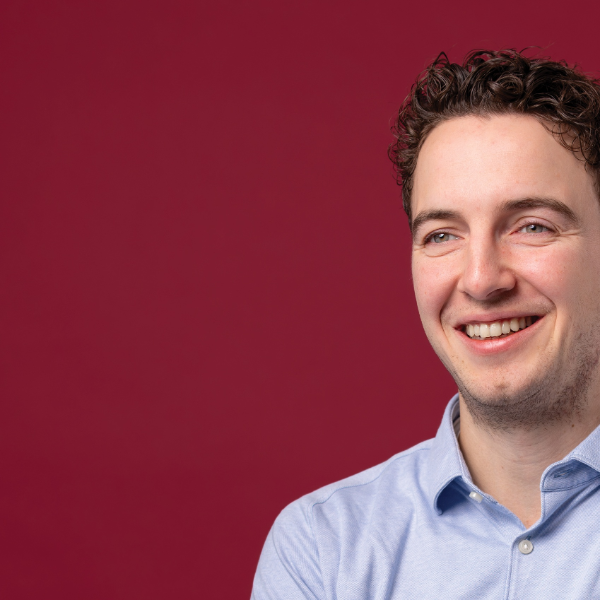
Rayaan Ajouz
Employee portrait
Rayaan Ajouz
‘Structural engineering lends itself perfectly to programming’
‘I began in building engineering. I wanted to be an architect. But I soon became disappointed by the lack of attention for technical skills: are these ideas technically possible? I didn’t want to design something wonderful only for it to be changed later because it was structurally unfeasible. To really push boundaries, I needed to know where they lay. That’s why I moved to civil engineering.’
Line by line
‘It was a difficult change. Suddenly my days consisted of doing calculations. As a structural engineer, you simplify reality into a formula. The trick is simplifying it in the right way – being conservative but not missing anything. Once you’ve done that, the rest is really just one big flowchart. You change the initial values, calculate, check, and then follow the same procedure again and again. That’s why it lends itself perfectly to programming.
‘I was inspired by people online who showed me how to automate processes. I started with simple scripts and Excel-like solutions and taught myself programming step by step. I spent weeks going through code line by line to understand what it did. But once I realised it was logic, not magic, I started to enjoy it.’
Expectations
‘I now work on infrastructure projects, such as tunnels and bridges. They provide a great opportunity to combine structural engineering with programming. Together with my colleagues, I’ve developed various digital tools for automatically performing calculations on design variants. So instead of performing a single calculation manually, we can now compare multiple scenarios and demonstrate more effectively which solution is safest and most efficient.
‘You might think: if you automate something, you can take an extra day off. But expectations change too. Now I’m asked questions like, ‘Can you do five more variants tonight?’ It all improves the quality of our advice. We’re becoming less restricted by our own calculating capacity and more the designer of the system. When I see a colleague using my tool, I see my work literally making a difference.’

Atypical structural engineer
‘The stereotypical structural engineer is a modest, conservative specialist who prefers to work behind the scenes. I’m maybe a bit atypical. I have a building engineering background, am visual by nature, and believe it’s important to tell stories. That makes things difficult, but I’ve trained myself to feel comfortable in the spotlight. I tell myself the worst thing you can do is not try.
‘On Dag van de Constructeur, the day honouring structural engineers, I was chosen as the year’s best young talent. That felt like validation for the slightly unconventional path I’ve chosen. In the years ahead, I want to be more involved in the front end of projects and, together with clients, decide how to employ digitalisation. That means not just designing structures but also contributing to decisions on how assignments – possibly digitally – are carried out.’