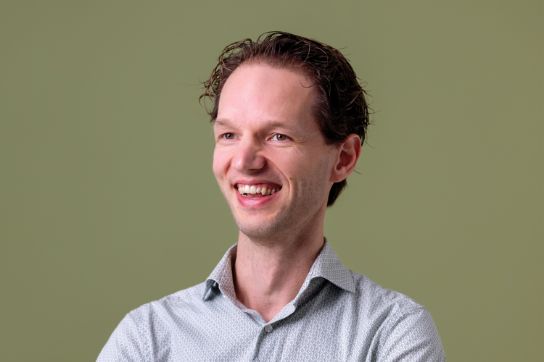
Jan Willem Slaa
Employee portrait
Jan Willem Slaa
‘If you eliminate every possible risk, then nothing actually happens’
‘Everyone wants a clean manufacturing industry, but chemicals – in other words, hazardous substances – will always be needed. That’s the field of tension I work in. If you choose to exclude all hazardous substances, then you miss opportunities and prevent innovative technologies from developing.’
Knowledge and creativity
‘Of course, working with hazardous substances involves risks. But if you eliminate every possible risk, then you’re optimally cautious and … nothing actually happens. For me, it’s about identifying risks, weighing up interests, and determining how innovations can proceed responsibly. That requires data, knowledge of substances as well as the law, and sometimes creativity. I want to understand the exact cause of things. Only then can you give good advice. But what if there’s no standard? How do you determine what’s responsible?
‘My background is in chemistry. I was attracted by the puzzles it presents: working at an abstract level with molecules you can’t see. But during my studies, I kept asking myself, ‘How does this help society?’ Pure science is fascinating, but it was too far removed from the real world for me. I wanted to understand how chemistry, the environment, and society are connected. So I did a master’s in energy and environmental sciences.’
Nuanced explanations
‘At Witteveen+Bos, I was given space to explore that interaction further. I began in the Hazardous Substances group with the idea that traditional industry knowledge is necessary to make a sustainability transition possible. The group has a great dynamic and works on a wide range of assignments.
‘At the same time, there’s an inherent tension. We advise on hazardous substances, while sustainability is often associated with avoiding their use. That requires nuanced explanations. Our role is to make responsible innovations possible – it’s a discipline that isn’t always understood.’
Space for innovation
‘How do you create a sustainable, future-proof society? We do a lot of work for industrial clients who want to become more sustainable. We help them deal with environmental legislation and permit applications.
‘The new Avantium factory in Delfzijl is a good example. It produces bio-based plastics from sugar – an alternative to fossil fuel-based plastics. This involves new, industrial-scale chemical processes using substances that no one has much experience with. That can make it difficult to obtain permits, as legislation is not always tailored to such situations. But by carefully analysing the risks and justifying them effectively, space can be created for introducing innovations like this responsibly.’