Widening of Yangtze Canal in Maasvlakte, Rotterdam
Widening of Yangtze Canal in Maasvlakte, Rotterdam
Economic growth need not hold back sustainability. Proof of this is visible on the project to widen the Yangtze Canal, one of the most important waterways in Rotterdam’s Maasvlakte.
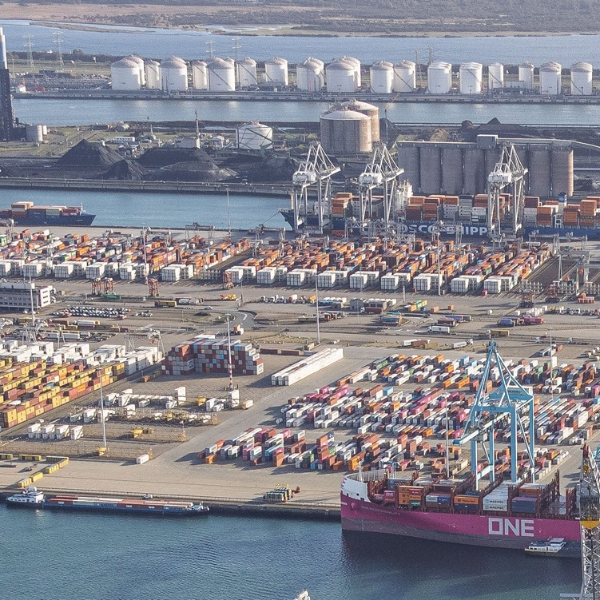
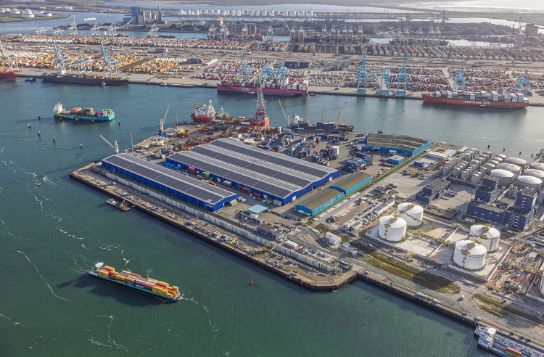
The Yangtze Canal was created in 2012, when the former Yangtze Harbour was converted into a waterway connecting the Beer Canal with the harbours of Maasvlakte 2. The canal now serves as the gateway to several harbours, including the Prinses Amalia, Prinses Ariane and Prinses Alexia Harbours. The Euromax container terminal is located on the canal’s north side.
Pushing boundaries together
Under a framework agreement for maritime engineering services, we are working with the Port of Rotterdam Authority and their contractors on implementing sustainable measures in designs and during construction. These include using smart tools and ECI-CO2 analyses to compare alternatives and reduce materials use; integrating shore power or autonomous power supplies into projects; and advising on sustainable tendering criteria. We are also collaborating with the Port of Rotterdam Authority on studies and pilots, including soil and materials studies, clean and zero‑emission construction, and innovative materials such as geopolymer concrete. Together, we are pushing our boundaries, and we hope to inspire other companies in the industry to do the same.
Limiting carbon footprint
The Port of Rotterdam is getting busier and busier, and the container ships sailing in and out of the port are getting bigger and bigger. To give these ships more room to pass one another and safely enter and leave the port, the Port of Rotterdam Authority is widening and deepening the Yangtze Canal along its entire length. Two new quay walls are being built to make this possible, with limiting their carbon footprint being an important consideration.
New quay for twelve tugboats
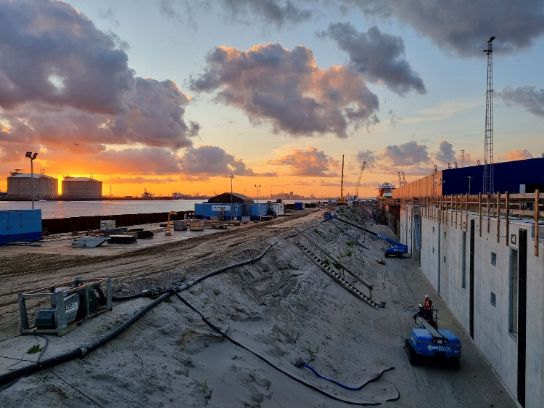
In two distinct phases, one quay will be designed and constructed for tugboats and another for inland vessels. In phase A, which has now almost been completed, Witteveen+Bos is supervising construction. This has involved building a 500-metre-long quay based on our design and specifications. The new quay offers space and provides shore power to twelve tugboats. The quay is adjacent to the Port of Rotterdam’s entrance and thus close to the largest container terminals. Its construction lays the foundation for the actual widening and planned deepening of the canal. In phase B, the involved parties will collaborate in a construction team.
Phase B: 1450 metres of geopolymer concrete
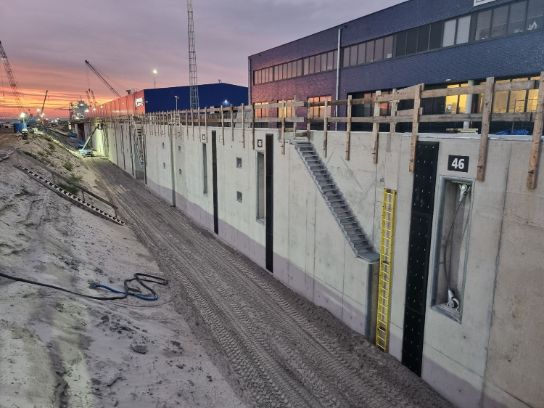
In technical terms, the activities in phase B – which commences mid-2026 – resemble those of phase A, but the scale is much larger. Over three years, the construction team is tasked with building a 1450-metre-long quay wall. To help the Port of Rotterdam Authority meet its sustainability goals, the wall’s superstructure will be made entirely from geopolymer concrete. This is a sustainable, cement-free alternative to traditional concrete that can reduce carbon emissions by up to 50 %, making it possible to build a quay with a much smaller environmental footprint.
Precise calculations, significant materials reductions
Another challenge the construction team faces in phase B is the location of the new quay wall, which is close to assets crucial for the surrounding area. Many underground pipes are present, and the Antarcticaweg road runs close by. Partly for this reason, the choice was made for a vibration-free diaphragm wall trench technique. This also allows us to exploit our experience with diaphragm walls on other projects, including the Oosterweel Link in Antwerp. On that project, we developed a diaphragm wall tool that enables us to calculate as precisely as possible, resulting in significant materials use reductions.
Climate-neutral by 2050
When the Yangtze Canal project is completed around 2029, it will constitute an important contribution to the Port of Rotterdam Authority’s goal to be climate-neutral by 2050 while remaining economically healthy and competitive.