PAGW North Holland Markermeer coast
Design study for a more robust ecosystem by stimulating nature
PAGW North Holland Markermeer coast
The Markermeer is ecologically vulnerable due to declining biodiversity, insufficient connections and a shortage of spawning and living areas. As part of the government's Programmatic Approach to Larger Water Bodies (PAGW) programme, Witteveen+Bos carried out a MIRT Exploration to strengthen the robustness of the ecosystem by improving or creating habitats for birds and fish. Our landscape designers took care of the planning process, design and visualisation for seven promising locations.
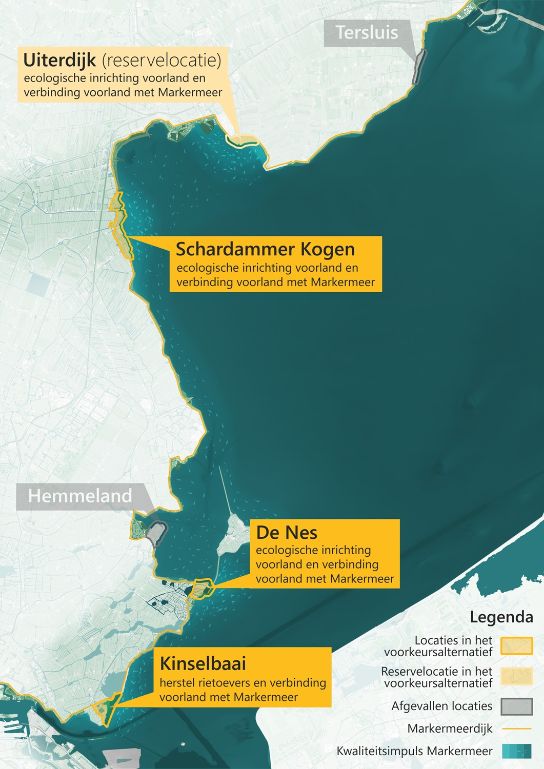
The seven promising locations are situated along the Markermeer coast between Enkhuizen and Amsterdam. In an integrated process involving ecologists, site managers and professional stakeholders, Witteveen+Bos collaborated with BWZ Ingenieursdiensten to draw up the designs for the various locations.
Well-functioning ecosystem
The most promising locations were then selected based on the substantiation and visualisation of the design variants. During this decision-making process, the variants were assessed by domain experts in terms of ecology, environmental impact, feasibility, costs and cost-effectiveness. In order to create a well-functioning ecosystem for the entire area, the locations Kinselbaai, De Nes, Schardammer Kogen and Uiterdijk were selected as preferred alternatives.


Habitat stimulation adjustments
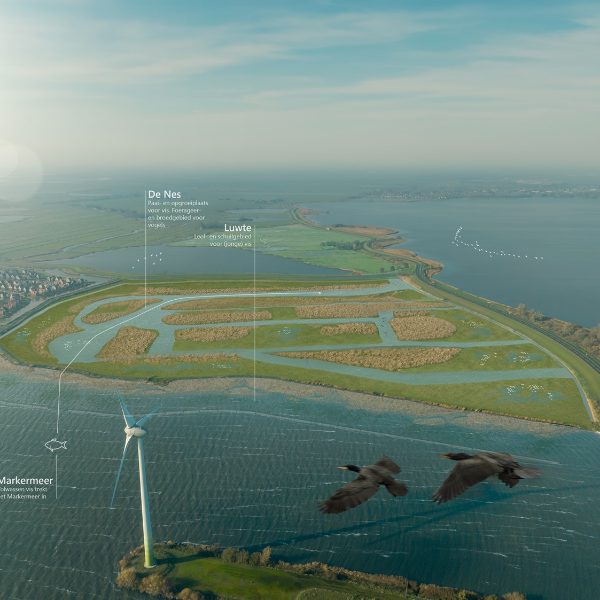
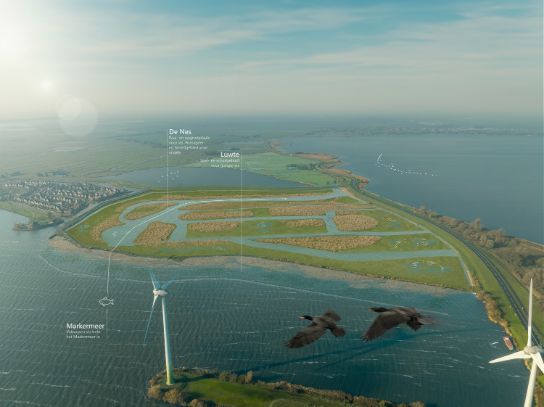
To improve and create habitats for birds and fish and improve water quality, the following new fish migration facilities, among others, will be set up as spawning and rearing areas for fish. Among other things, natural bank habitats will be created, a gradual transition from water to land will be provided and realised, zones with shallow and clear water will be added, transitions in water depths will be reinforced and the areas outside and inside the dykes will be connected.
Project information
- Client: Rijkswaterstaat, Staatsbosbeheer, RVO
- Location: IJdoorn to Enkhuizen
- Type of project: Nature development, MIRT exploration
- Duration: 2024
- Implementation: expected 2025