Heysel Sports Park
Engineering as the driving force behind green transformation
Heysel Sports Park
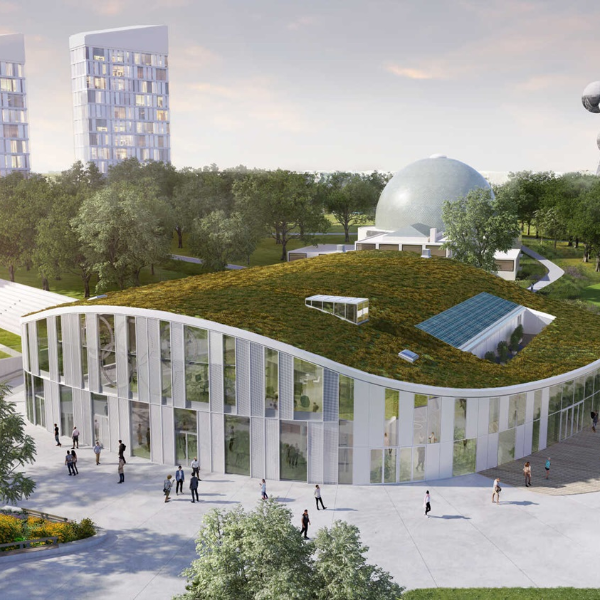
In the shadow of the Atomium in Brussels, the Heysel Sports Park is undergoing a transformation into a modern, adaptive and sustainable sports facility. In the dynamic environment of the former EXPO site, the focal points are the construction of a new clubhouse with a large cantilever and the addition of a new shell to the existing sports building. Witteveen+Bos is responsible for the engineering of the structure (stability) and installations (special techniques) for these specific parts.
Together with the landscape architects of OMGEVING (Antwerp) and ARA (Antwerp) and the architects of Zwarts & Jansma (Amsterdam), Witteveen+Bos won this contract by winning the design contest for this sports park in 2017.
The starting point for the modernisation of the park is a landscape and organic design that contrasts sharply with the linear layout of the surrounding area. Special attention has been paid to the smart use of the current large differences in ground levels. The sports clusters will be integrated into the landscape and an open water cascade will be created to collect and display the water from the grounds.
In addition to an attractive public park area, the sports park will include an athletics track, a Finnish track, football, rugby and hockey pitches and the largest public water playground in Belgium. The park has a number of guaranteed users, such as the clubs and associations that have or will have their place there, and the existing residents of the surrounding neighbourhoods. The sporting needs of future residents have also been taken into account.
The current sports building will be given a prominent position and function in the park. It will therefore be given a facelift. The existing building will be retained, but will be extended with a completely new shell around it. The result will be a modern look. Catering facilities directly behind the new glass façade will serve the clubs and visitors to the public park. The sports facilities, including a sports hall on the first floor and the new head office of the Belgian Olympic Committee, will remain in the existing building.
Witteveen+Bos is responsible for the structural and technical design of both buildings within the project team. The final design has now been approved, the contractors have been selected and the tender process is underway. The transformation of the Heizel Sports Park is expected to start in Q4 2025/Q1 2026.
Rugby stadium for 5,000 spectators
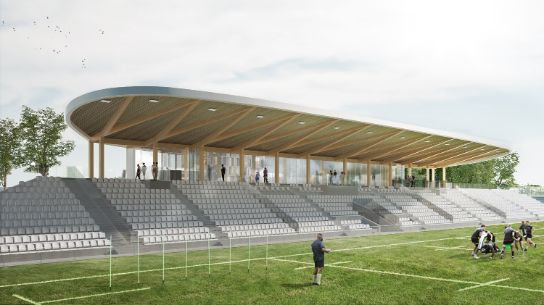
The new rugby stadium will play a prominent role in the transformation of the Heizel Sports Park. The facility will be the most modern in Belgium, with a capacity for 5,000 fans, who will be able to enjoy matches in the Rugby Pro League.
The clubhouse on the long side of the rugby field is semi-underground, taking into account the existing large differences in ground levels. The spacious layout offers room for modern facilities, such as VIP boxes and a press room, changing rooms, treatment rooms for physiotherapy, etc.
The desire to accommodate 5,000 spectators has been translated into a ground wall with seating and two stands. These stands presented the experts at Witteveen+Bos with interesting structural challenges.
The clubhouse will be equipped with a canopy with a large overhang above the seats. The dimensions of the concrete substructure take into account the substantial canopy. A multitude of factors played a role in the design of the canopy itself and the calculation of the structure, such as wind load, whereby not only the downward but also the upward forces were investigated, and the load in the event of snowfall. Sustainability played an important role: a wooden structure was chosen.
The grandstand on the other long side is also semi-underground, giving it a dual function as a retaining wall for the lower field. It is also equipped with a canopy to provide comfort for spectators. To enable the cantilever, the concrete substructure has been fitted with cross walls in this case. This achieves the desired rigidity.
Our geotechnical specialists provided input on aspects such as the stability and spring stiffness of the subsoil for both the clubhouse and the grandstand. Important data was incorporated into the designs.
An extra shell transforms a sports hall into a multifunctional building
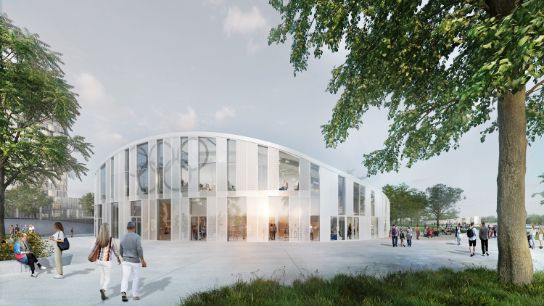
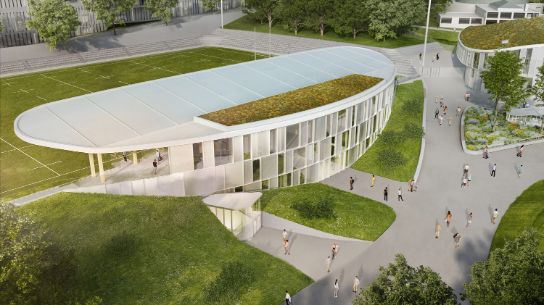
Once completed, the existing sports hall will be unrecognisable, but it will remain part of the new large multifunctional building. A shell will be placed around the existing sports accommodation, combining sports, offices and recreation.
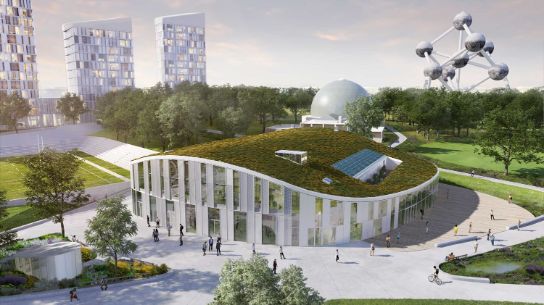
The innovative building will house the Belgian Olympic Committee, which will be emphasised by the Olympic rings on the glass façade. The Royal Archers will also find a home here, as will the changing rooms for the players of the adjacent new stadium, a large sports hall on the upper floor and a grand café with a south-facing outdoor terrace where the people of Brussels can relax.
The decision to encase the existing building presented an interesting puzzle for the engineers at Witteveen+Bos. The existing part and the new outer ring are largely vertically separated from each other. This prevents the settlement effects of the new part from affecting the sports hall, which has already settled into its final shape. To ensure the stability of the structure, for example in terms of wind resistance, the structures are connected horizontally.
Our geotechnical engineers were also involved in the design of the structure to take into account the stability and stiffness of the subsoil, among other things. The promotion of biodiversity and the reduction of heat stress have also been taken into account: the building will have a sedum roof.