Energy supply for business parks
An action perspective
Energy supply for business parks
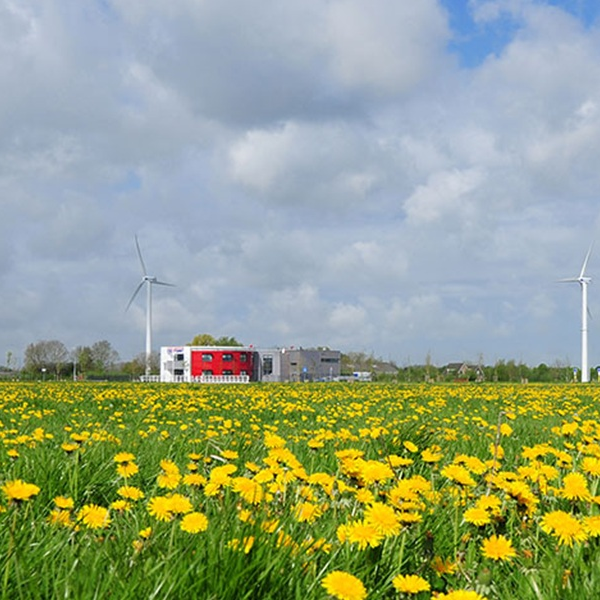
Business parks in the Netherlands are facing challenges due to grid congestion. This restricts the ability of companies to expand or make their processes more sustainable. The Breekland business park to the north of Alkmaar is a typical example. At the instruction of Centrum voor Verduurzaming in Alkmaar, a regional centre for sustainability, we identified collective and individual solutions for companies at this park and outlined transition pathways. An exercise that offers an action perspective.
At the Breekland business park, several companies are struggling with the restraints imposed by grid congestion. Some entrepreneurs need more electricity, but are unable to upgrade to a higher-capacity connection because the grid is already stretched to the limit. Further growth is impossible. Some of the new entrepreneurs at the Breekland park are even not able to obtain a connection to the grid at all. Put briefly: the situation is far from ideal.
Far from ideal
To create a clear picture of the current supply and demand patterns, experts from Witteveen+Bos performed surveys at the companies to identify how much energy they consume and feed back into the grid. The entrepreneurs were also asked to provide a forecast of their consumption and possible excess capacity. During the process, we and the grid operator identified which companies were ‘neighbours in the grid’ and investigated the possibilities for a smart energy hub. Based in part on this information, individual and collective measures – building blocks – were developed to help mitigate or minimise the effects of grid congestion.
Arsenal
According to research conducted by CE Delft, there is an extensive arsenal of different individual and collective building blocks from which companies can choose. These approaches allow entrepreneurs to take action themselves without having to rely on third parties. Examples include demand response, additional generation, storage, conversion and alternative contract forms. There are also collective arrangements in which the companies involved share a single grid connection. The examples here include a direct line and a group transmission agreement (known as ‘groeps-TO’ in the Netherlands).
Transition pathways
These building blocks are optimally deployed and/or combined using transition pathways. In a transition pathway, the building blocks are selected and arranged in such a way that they follow on from one another in a logical sequence over time. For an individualised approach, demand-responsive strategies such as smart charging or switching to three-shift working are effective methods that can be adopted by companies at the Breekland business park. Some entrepreneurs at the site could also benefit from storing electricity locally in a battery and then using the stored electricity during peak periods.
Collective approach in the Smart Energy Hub
In the case of several large-scale consumers at the Breekland business park that participated in this study, it makes economic sense to explore collective solutions. In this context, a Smart Energy Hub (SEH) solution based on a collective transmission agreement (combined with storage and generation) is particularly effective. Ideally, a collective arrangement of this type should start with between two and no more than five parties, after which consideration can be given to how to establish the criteria for the SEH. From a technical perspective, this is best achieved by prioritising collective storage of electricity in a battery (in combination with generation) for deployment primarily in the winter period.
Important first step
This study is an important first step. It highlights the individual and collective options available to companies for making their energy supply more resilient. Coordination with the grid operator and the relevant government authorities is essential for monitoring developments and seizing new opportunities in a timely manner. Thanks to our work, Breekland can now steadily develop a future-proof, resilient and sustainable energy supply.