DC eHubs
Grid congestion is a growing problem: the overloading of the public electricity grid is stalling the transition to clean energy. It will take time to reinforce our grid. We must find creative and innovative solutions in the meantime.
To relieve grid congestion, we need more capacity and flexibility. Tapping the overcapacity from traction networks may help.
Traction networks
Large portions of the public transport system, such as railways, the tram networks of The Hague, Rotterdam, Amsterdam and Utrecht, and the trolley buses in Arnhem, have their own electricity grids called ‘traction networks’. These networks are far from using all their capacity at all times of the day. Integrating traction networks with charging infrastructure, solar power and energy storage can improve energy exchange and promote the energy transition in urban areas. The development of innovative and scalable direct-current energy hubs (DC eHubs) has a role to play.
Energy exchange
DC eHubs can promote integration by means of energy exchange between traction networks, charging infrastructure and solar power. DC stands for ‘direct current’, which is what traction networks use. Connecting this to the (alternating-current) electricity grid poses several challenges. We can link a DC traction network to local DC networks with solar power, charging infrastructure and energy storage to create a local microgrid, which reduces the load on the public electricity grid.
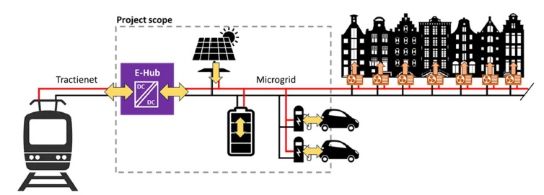
DC-DC converter
The DC eHubs project focuses on developing an innovative and scalable concept for DC eHubs. The technical concept covers the hardware (such as a DC-DC converter) as well as the software and control technology. Witteveen+Bos is studying the technical, economic and social frameworks in which a DC eHub would operate. The project is developing a variety of DC eHub models that may be effective in different real-world situations.
Research and development
This project builds on two preliminary studies: TSDCE (Traction network to Smart DC Electricity network) and SAP-DC (Safe and Autonomous controlled PV charging plaza with DC distribution). The Amsterdam public transport operator (the GVB) has integrated these preliminary studies into a new field lab. This study supports the iterative development of the concept, with continuous integration of feedback and knowledge from the field study, to further refine, validate and scale up the concept. The project is a collaboration between theThe Hague University of Applied Sciences, the Amsterdam University of Applied Sciences, DC Opportunities R&D, the GVB and Witteveen+Bos.