WFD: clean water for Vechtstromen water authority
WFD: clean water for Vechtstromen water authority
The quality of groundwater and surface water in the Netherlands is endangered by threats that include the leaching of phosphate and nitrogen. Under Europe’s Water Framework Directive (WFD), water authorities are responsible for ensuring the quality of these waters. One such water authority, Vechtstromen, is currently working together with Haskoning and Witteveen+Bos to make eight of its wastewater treatment plants ‘WFD-proof’ – a huge task with a strict deadline.
WFD is a European directive on the quality of groundwater and surface water in the EU. It has been individually adapted to every major waterbody in the Netherlands. A uniform WFD for all waters is not possible, as the quality requirements of a waterbody depend on its type and location. A pond in a nature area, for example, is very different to a canal. But in each case, the water must provide a healthy habitat for aquatic flora and fauna.
The good news is that water quality in the Netherlands has improved in recent decades. Certain regions still face challenges, however, and so does Vechtstromen, whose area of responsibility crosses Gelderland, Overijssel and Drenthe.
Reducing phosphate and nitrogen levels
Various measures are available to water authorities to improve water quality, such as removing barriers for fish, installing fish ladders, reintroducing the natural meanders of streams, or restoring natural groundwater flows.
Another measure involves wastewater treatment plants. By treating their effluent to reduce the levels of phosphates (phosphorous) and nitrogen, these plants can help meet WFD targets. After all, excessive amounts of these nutrients lead to algae growth and oxygen depletion, which has negative consequences for the level of biodiversity in surface water.
Parallel approach
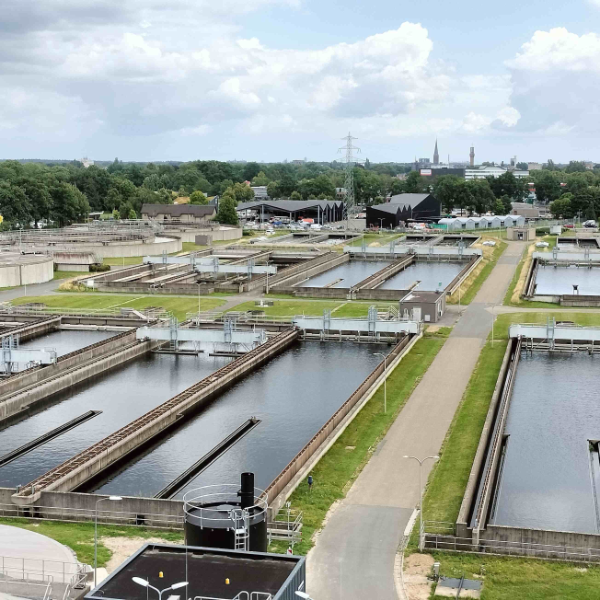
Of Vechtstromen’s 23 wastewater treatment plants, 9 need to be modified so that their effluent meets the target values for their discharge areas. One plant, in Tubbergen, is being modified by the water authority itself. For the other eight plants – in Oldenzaal, Haaksbergen, Goor, Glanerbrug, Enschede, Hengelo, Nijverdal and Denekamp – Vechtstromen is teaming up with Haskoning and Witteveen+Bos.
The unique aspect of this collaboration: it is the first time a WFD task is being approached as a programme, with the design, modification and construction work for each plant being carried out partly in parallel rather than one after the other. In light of the deadline posed by WFD, 1 January 2028, this urgency is required. And, of course, the objective for all plants is the same: reducing the aforementioned nutrient levels.
Escaping traditional roles
The three parties involved in the programme are not working in traditional client/contractor roles, but instead as an integrated programme team that provides programme-wide direction.
At the project level, a design team populated by the engineering firms works on each plant, while a central review team from the water authority assesses the (interim) products. This review team includes representatives from all departments within the water authority, ensuring that an integrated assessment takes place. The parties employ this approach to jointly produce both a preliminary and detailed design for each plant. From the detailed design phase, contractors are brought in on each project using a construction team set-up.
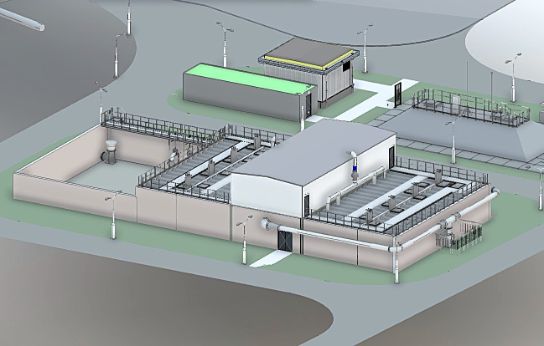
The argument underlying this approach is that all the plants face similar challenges. At every location, the existing plant needs to be modified. Four plants will also be fitted with sand filters, and two with fabric filters. In the preliminary design phase, these elements are included as standardised building blocks. In the detailed design phase, they are further developed for each location.
Space and trust
The parties have since gained experience with this approach. Working with parallel teams requires regular communication and coordination, as well as a flexible attitude from all parties. Standardising building blocks, for example, costs more time at first but saves time later.
A well-equipped project environment for parallel collaboration – both a physical location and a shared digital environment – is also absolutely essential for taking on challenges of this complexity. But it is not enough on its own. Ultimately, success comes down to partnership and trusting each other’s expertise, so that all parties have the space to generate added value.
At the start of this year, the detailed designs for the plants in Hengelo (Overijssel), Goor, and Denekamp were completed and construction work began. Ultimately, all plants must be operational by no later than 1 January 2028.
Starting well makes all the difference
‘A programme-based approach, which includes using standardised building blocks, costs more time at first compared to a custom approach for each plant. But later in the process, we end up saving time,’ explains Vechtstromen’s Jeroen Ensink op Reimer, who is involved in the programme in a number of roles, including as a core team member.
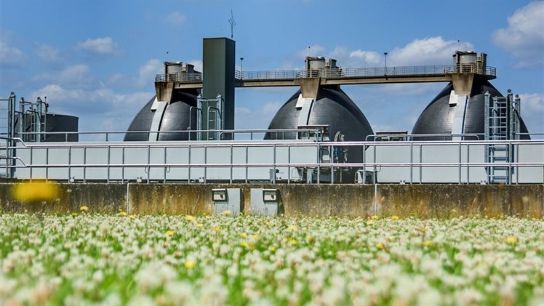
Various building blocks have been developed on the programme, including for the sludge thickening building, the fabric and sand filters, and the methane storage structures. ‘We got various disciplines within the water authority involved, developing the blocks together in the preliminary design phase. Later, in the detailed design phase, the detailing and adaptation is done for each location.’
One of the building blocks has since been used in a treatment plant outside the programme. ‘That’s a nice bonus. It will save a lot of time and energy if the blocks are rolled out further. It creates organisational transparency, and we don’t have to start from the beginning each time.’