Centralised sludge processing
Increase in sustainability and efficiency
Centralised sludge processing
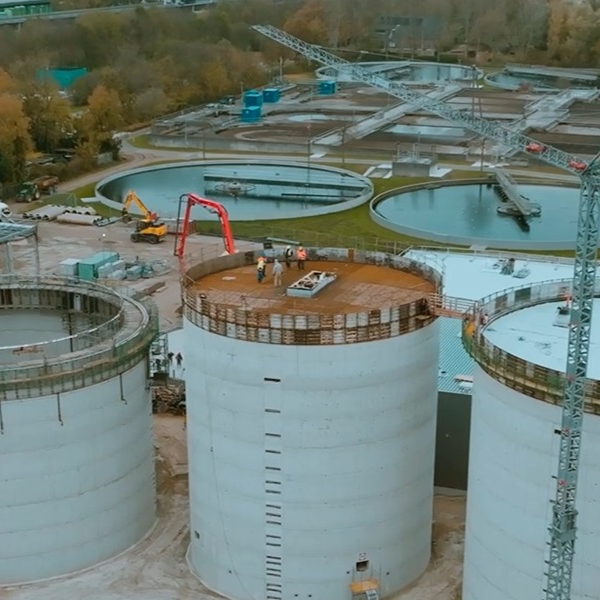
At the sewage treatment plant in Ede, the Vallei en Veluwe water authority is centralising sludge processing for its southern treatment area. Through centralised processing, the water authority aims to organise its sludge digestion processes more efficiently, start producing green gas, and recover CO2. The installation at Ede thus represents a big step forward in the water authority’s circular sewage treatment ambitions.
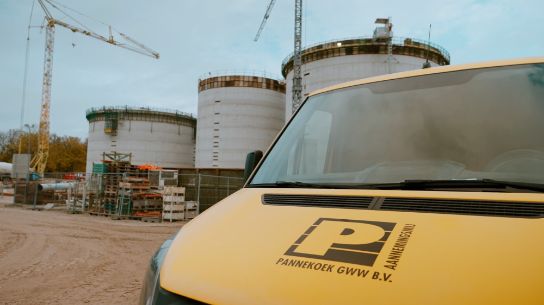
For the design and construction of the installation, the water authority is working together with CLC Water, a collaboration involving ADS Group, Witteveen+Bos, Pannekoek GWW, and Moekotte. On this project, CLC Water is being supported by Iv.
In the form of a construction team, these parties collaborated on the installation’s design, and since 2025 CLC Water has worked on its construction. The new installation will take over the task of sludge processing from the sewage treatment plants in the southern region, located in Veenendaal, Renkum, Woudenberg and Bennekom.
Energy for 2,200 households
Centralisation of sludge processing will result in increased processing efficiency and sustainability, as well as a proportional increase in biogas generation. In a separate installation, this biogas will be converted into (i.e. upgraded to) green gas, after which it will be fed into the natural gas network.
The green gas produced can supply 2,200 households with energy each year. The CO2 captured during the upgrading of the gas will be used as a raw material in industry. The installation’s design also takes sustainability and circularity into consideration, employing sustainable materials such as bio-based insulation material and geopolymer concrete.
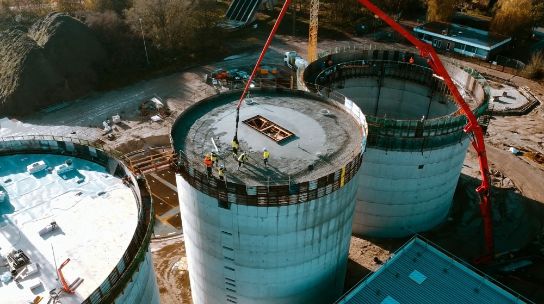
Geopolymer concrete has a significantly lower carbon footprint than conventional cement concrete. Cement concrete contains clinker, the production of which emits relatively large amounts of CO2 (8 % of global emissions). In geopolymer concrete, the role of clinker is taken over by industrial by-products such as blast furnace slag and fly ash, which are alkali-activated.
‘According to the Eurocode, geopolymer concrete has similar properties to concrete – for example, compressive strength,’ explains Jan Treure, concrete technology consultant at W+B. ‘It also offers additional properties in certain applications. In sludge digestion, acids are released that damage cement concrete. To protect against this, a plastic lining is often used, which needs to be regularly replaced. Theoretically, geopolymer concrete eliminates the need for this lining. The result is concrete with a significantly longer usage lifespan and virtually no need for maintenance.’
Complex and challenging
Vallei en Veluwe describes the undertaking as a complex and challenging task in which affordability and feasibility in the construction and operation phases are being closely monitored.
By explicitly defining construction and operation requirements and incorporating most of these into the systems engineering of the design phase, uncertainties surrounding construction scope and costs were effectively managed. During various 3D review sessions and safety studies before construction began, issues including feasibility, safety and operation were thoroughly verified together with operators and construction partners – a perfect example of how effective a good start can be.
Project update
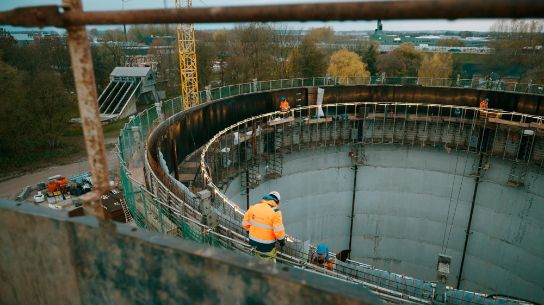
In the summer of 2025, construction of the central sludge processing installation in Ede began in symbolic and festive fashion. The design and construction team phase was completed in nine months, and with the project now in the construction phase, completion is expected in 2027.