Pilot project for biodiversity research using airborne eDNA in Reevediep
Pilot project for biodiversity research using airborne eDNA in Reevediep
Is it possible to identify which plant and animal species live in an area without spending hundreds of hours on fieldwork? That is what Witteveen+Bos, EcoPulse, TNO and Datura are testing this summer in the Reevediep, a new waterway near Kampen, between the IJssel and the Drontermeer. Using environmental DNA, eDNA for short, researchers are collecting and analysing DNA traces. This provides a picture of the plant and animal species present in an area. This is already commonly done using water and soil samples, but what makes this pilot project particularly special is the use of innovative air sampling.
Faster, more comprehensive and less disruptive
Traditionally, ecologists map biodiversity by conducting field surveys of plants and animals. This is time-consuming, labour-intensive and can disturb the natural environment. With eDNA, part of this survey can be carried out more quickly, more comprehensively and with less disruption.
eDNA does not replace traditional fieldwork, but is a valuable addition. The eDNA method can help to detect species more quickly and conduct more targeted research. The method is becoming increasingly advanced and affordable, and is therefore more widely applicable. As a pilot project and as an investment in joint knowledge development, Witteveen+Bos, EcoPulse, TNO and Datura are sampling and analysing biodiversity in the vicinity of the Reevediep. This is a new waterway near Kampen that has been constructed as part of the ‘Room for the River’ programme.
Reevediep
The Reevediep is a suitable location for testing the eDNA method. The area was recently developed on behalf of Rijkswaterstaat and the province of Overijssel. The former polder has evolved into a wetland that is still developing. Birdwatchers from all over the country are already flocking there to admire species such as the red-crested pochard, ruff, common tern, bittern and white-tailed eagle.
Sebastiaan Schep, from Witteveen+Bos, is the initiator of this pilot project: ‘To achieve the necessary improvements in biodiversity, we need to make biodiversity as a whole more measurable. When I heard about the latest developments in measuring airborne eDNA, I wanted to test this on a practical scale as soon as possible. The Reevediep, an area development on which we at Witteveen+Bos have acted as consultants, is ideally suited to this.’
'We are comparing the Reevediep with a polder that resembles what the area used to look like. We are doing this by comparing the eDNA analysis results from both areas. To do this, we are taking air samples from the surrounding area.'
Sebastiaan Schep
Metamorphosis
The province of Overijssel is very interested in the results. ‘We have been working on the project for years and have witnessed first-hand the transformation from a polder and meadow bird area into a wetland,’ says Arjan Otten, strategic nature adviser at the province of Overijssel. ‘We have always monitored the development of plants, animals and habitats. But we have never properly mapped out how biodiversity as a whole has changed.’
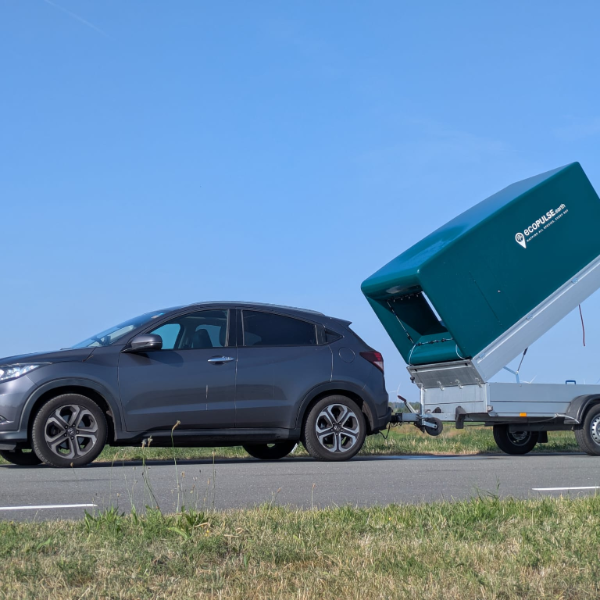
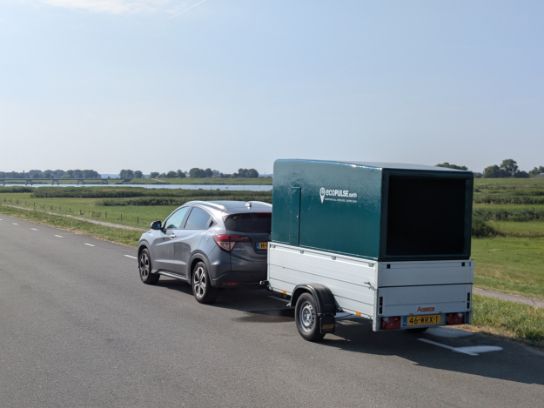
Sebastiaan Schep: ‘We are comparing the Reevediep with a polder that resembles what the area used to look like. We do this by comparing the eDNA analyses from both areas. To do so, we take air samples from the surrounding area. EcoPulse uses its mobile system along a number of pre-determined routes, enabling thousands of cubic metres of air to be sampled across a large area in a short space of time. TNO has set up a fixed monitoring point at the Scheeresluis, which records changes over time from that specific location. The two methods are therefore complementary. In addition, water and soil samples are collected. The collected eDNA is analysed in Datura’s laboratory.’
How does eDNA work?
Every living organism constantly leaves behind microscopic traces of DNA. Examples include skin cells, hair, faeces, saliva, mucus or pollen. By analysing these traces from the air, water and soil, it is possible to determine which species are present in an area. For example, it is interesting to see whether DNA traces of the water shrew or the great mudminer are found. Special habitats have been created in the Reevediep for both species.
More monitoring needed
The eDNA method shows great promise when it comes to monitoring and improving biodiversity in our country. ‘We are seeing a significant increase in the challenges involved in monitoring nature. Not so much in nature reserves but mainly outside them, such as in agricultural and urban areas. We will therefore continue to follow developments in the field of eDNA research with interest,’ says Arjan Otten. ‘But secretly, of course, I’m also hoping for new species in the Reevediep that we don’t yet know about!’